
Transmission Media: Wired vs Wireless
CSEC IT: Communication Channels
Essential Understanding: Transmission media is the physical path or wireless channel through which data travels from a source to a destination. Choosing the correct media depends on factors like bandwidth, distance, cost, and susceptibility to interference.
Key CSEC Learning Objectives
According to the CSEC IT syllabus, students should be able to:
✅ Distinguish between guided (wired) and unguided (wireless) media
✅ Describe the features of Twisted Pair, Coaxial, and Fiber Optic cables
✅ Describe the features of Radio, Microwave, and Satellite transmission
✅ Compare media in terms of speed, cost, and security
Types of Transmission Media
Transmission media is generally categorized into two broad groups: Guided Media (physical wires) and Unguided Media (wireless waves).

Twisted Pair Cable
Type: Guided / Wired
Description: Two insulated copper wires twisted together to reduce interference (crosstalk).
Variants:
- UTP: Unshielded (Cheaper, common in LANs)
- STP: Shielded (Extra foil, more expensive)
Pros: Cheap, easy to install.
Cons: Short distance, susceptible to EMI.

Coaxial Cable
Type: Guided / Wired
Description: A central copper core surrounded by insulation, a braided shield, and an outer cover.
Usage: Cable TV, Older Ethernet networks.
Pros: Higher bandwidth than Twisted Pair, better shielding.
Cons: Bulky, harder to install than UTP.

Fiber Optic Cable
Type: Guided / Wired
Description: Transmits data as pulses of light through glass or plastic strands.
Usage: Internet backbones, high-speed LANs.
Pros: Extremely fast, long distance, immune to EMI, highly secure (hard to tap).
Cons: Very expensive, difficult to splice/repair.
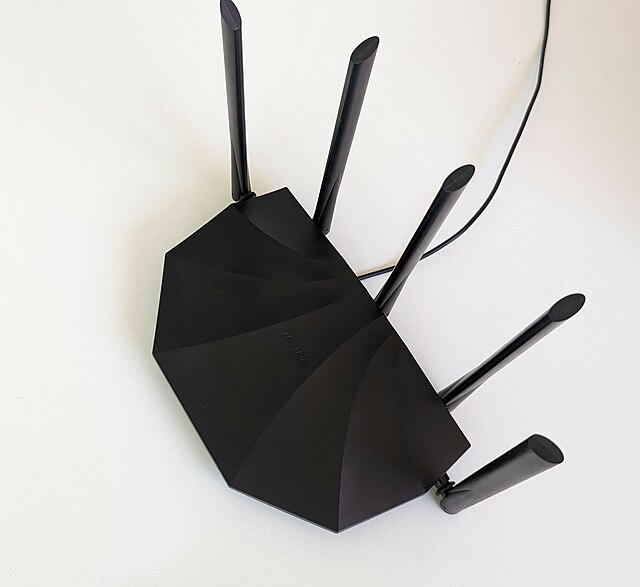
Radio Waves
Type: Unguided / Wireless
Description: Omni-directional waves that travel through air.
Usage: Wi-Fi, Bluetooth, FM Radio.
Pros: Portable, no cabling required.
Cons: Susceptible to interference, security risks (hackers).

Microwave & Satellite
Type: Unguided / Wireless
Microwave: Line-of-sight transmission (towers/dishes). High speed.
Satellite: Signals relayed from ground stations to space and back.
Usage: Mobile networks, GPS, Global TV.
Pros: Covers impossible terrain (oceans/deserts).
Cons: Expensive equipment, weather interference, latency (delay).
Media Performance Analysis
Comparison: Wired vs Wireless
| Criteria | Wired (Guided) | Wireless (Unguided) |
|---|---|---|
| Portability | Low (Restricted by cable length) | High (Can move freely within range) |
| Security | High (Physical access required) | Lower (Signals can be intercepted) |
| Reliability | High (Constant connection) | Variable (Affected by weather/interference) |
| Installation Cost | High (Drilling, cabling) | Low (No cables needed) |
| Speed | Higher (Especially Fiber) | Improving, but generally lower than Fiber |
Transmission Architect Challenge
Objective: Select the most appropriate transmission medium for the described scenario.
Twisted Pair (UTP)
Scenario: Connecting computers in an office LAN.
Why: Cost-effective and easy to install for short distances inside a building.
Fiber Optic
Scenario: Connecting banks or hospitals (High Security/Speed).
Why: Highest security and speed needed for sensitive data transfer.
Satellite
Scenario: Internet for a remote island village.
Why: Cabling is impossible over oceans. Satellite provides global coverage.
Microwave
Scenario: Connecting two office buildings 10 miles apart.
Why: Cheaper than cabling across a city and faster than satellite. Requires line of sight.
Remember: Cost vs. Benefit
When answering CSEC questions on media selection, always consider the trade-off. Fiber Optic is technically the "best" media, but it is too expensive for a simple home network. Twisted Pair is the industry standard for LANs because it offers the best balance of cost and speed for short distances.
CSEC Practice Arena
Test Your Understanding
CSEC Examination Mastery Tip
Comparison Keywords: When comparing media, use these CSEC-friendly terms:
- Interference: Fiber = None; Copper = Susceptible.
- Bandwidth/Speed: Fiber > Coaxial > Twisted Pair.
- Cost: Twisted Pair is cheapest; Fiber/Satellite are most expensive.
- Installation: Wireless is easiest to install; Wired requires cabling.