
Circle Theorems and Properties
The Geometry of the Circle
Essential Understanding: Circles are perfectly symmetrical, and this symmetry creates powerful rules linking angles and lengths. Mastering these theorems allows you to solve for missing angles without measuring—simply by spotting specific patterns.
1. The Anatomy of a Circle
Before starting theorems, students must master the vocabulary. A student who confuses a "sector" with a "segment" will struggle with worded problems.
A line segment from the center to any point on the circumference.
A chord passing through the center. The longest chord.
A straight line joining two points on the circumference.
A straight line that touches the circle at exactly one point.
Region enclosed by two radii and an arc (Looks like a pizza slice).
Region enclosed by a chord and an arc (The space between the chord and the edge).
2. The "Big Seven" Circle Theorems
Organize the theorems into a "Visual Gallery." For each theorem, identify the Definition, a Visual Trigger, and the Mathematical Rule.

The angle subtended by an arc at the center is twice the angle at the circumference.

Angles subtended by the same arc (or chord) at the circumference are equal.
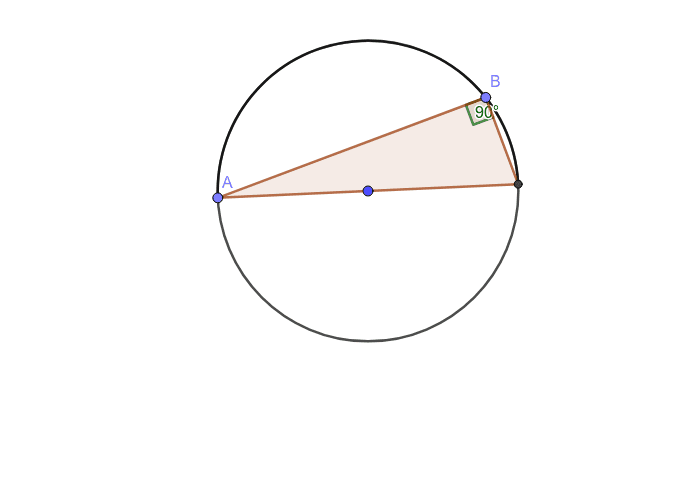
The angle subtended by the diameter at the circumference is always a right angle.

Opposite angles in a cyclic quadrilateral (all four vertices touch the circle) add up to \(180^\circ\).

A tangent is perpendicular to the radius at the point of contact.
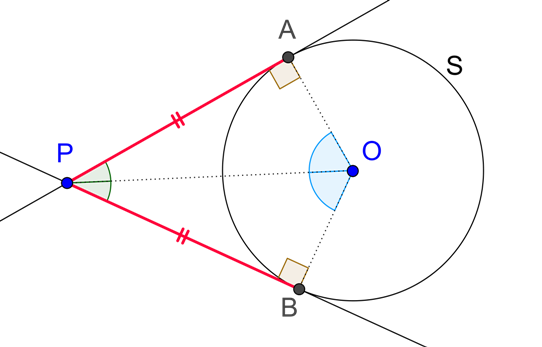
Two tangents drawn from the same external point are equal in length.
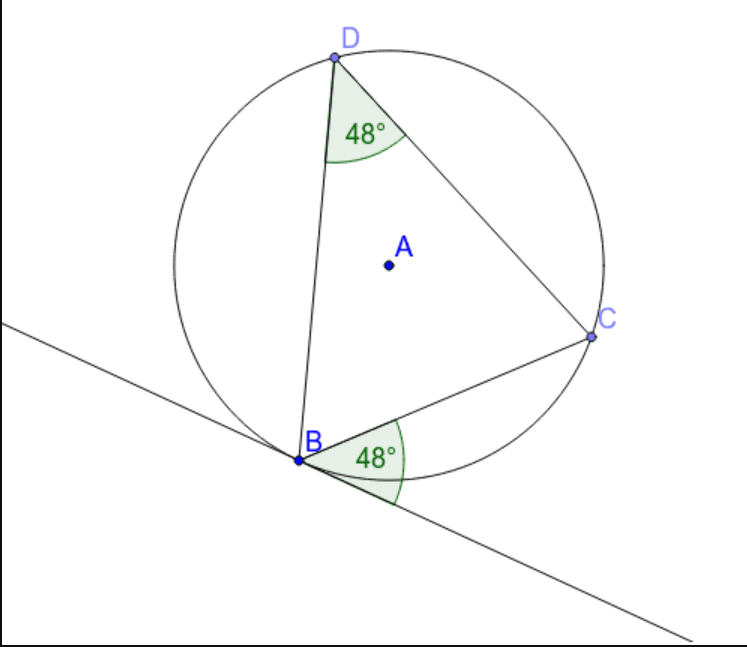
The angle between a tangent and a chord is equal to the angle in the alternate segment.
3. Interactive "Theorem Solver" Lab
Circle Theorem Explorer
Objective: Drag the three points A, B, and C around the circle. Observe how the angles change in real-time. Can you arrange them to form a Semicircle or make angles equal?
💡 Tip: Try to make Angle at Center exactly 180° (Diameter). What happens to the Angle at Rim?
4. The 3-Step Proof Strategy
CSEC often asks students to "give reasons for your answer." Teach them to structure their work:
Example: "Angle \( ABC = 50^\circ \)."
Example: "Angles in the same segment are equal."
Example: "Therefore, \( x = 180 - (90 + 50) = 40^\circ \)."
5. CSEC Exam "Trap" Detection
The "Center" Trap
Remind students to check if the line actually passes through the center (\(O\)) before assuming a \(90^\circ\) angle or using the "Center vs. Circumference" theorem. If it's not the center, the angle is just a standard angle subtended by a chord.
The "Isosceles" Secret
Many circle problems are solved by identifying radii. Since all radii are equal (\(r\)), any triangle formed by two radii and a chord is an Isosceles Triangle. Always look for these hidden isosceles triangles to find base angles!
6. Mastery Quiz: "Identify the Theorem"
Visual Recognition Check
Don't calculate. Just identify which theorem applies to the diagram.