
Bacteria: The Prokaryote Kingdom
The Structure and Importance of Bacteria in Decay and the Nitrogen Cycle
Introduction: The Microscopic Giants
Bacteria are unicellular, prokaryotic microorganisms that belong to the Kingdom Monera (Prokaryotae). They are among the most ancient and abundant life forms on Earth, found in virtually every habitat—from soil and water to extreme environments like hot springs and deep-sea vents.
Despite their microscopic size, bacteria play essential roles in maintaining ecological balance. They are crucial for:
- Decomposition and nutrient recycling
- The nitrogen cycle, making atmospheric nitrogen available to plants
- Human health and industry (both beneficial and harmful effects)
General Characteristics of Bacteria
- Unicellular: Each bacterium is a single cell
- Prokaryotic: No true nucleus or membrane-bound organelles
- Microscopic: Typically 0.5–5.0 μm in size
- Cell Wall: Contains peptidoglycan (murein)
- Reproduction: Primarily by binary fission (asexual)
- Genetic Material: Single circular DNA chromosome
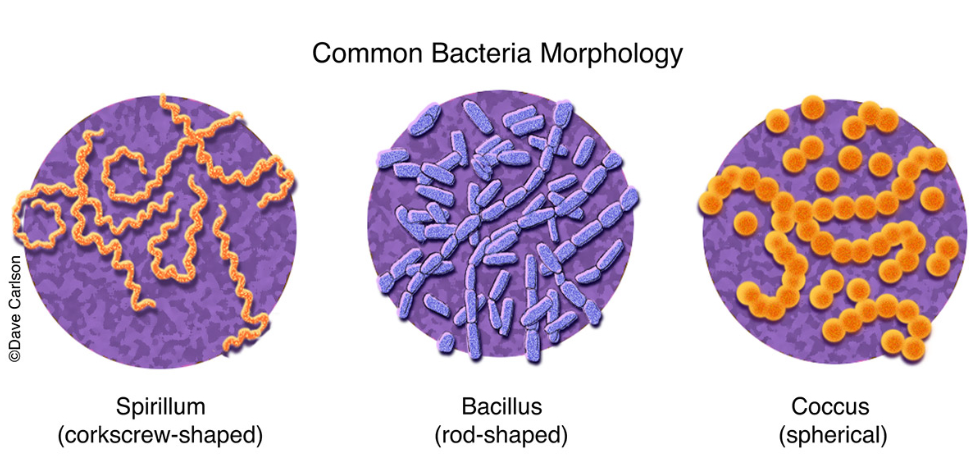
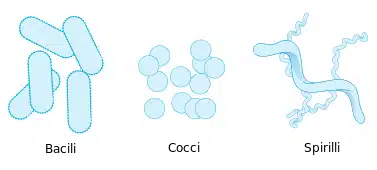
- Shapes: Cocci (spherical), bacilli (rod-shaped), spirilla (spiral)
Structure of a Bacterial Cell
Main Structural Components
- Cell Wall: Provides shape and protection; contains peptidoglycan
- Cell Membrane: Selectively permeable barrier controlling entry/exit of substances
- Cytoplasm: Gel-like substance where metabolic reactions occur
- Ribosomes: Sites of protein synthesis (70S type)
- Genetic Material: Single circular DNA molecule in nucleoid region
- Flagellum (plural: flagella): Whip-like structure for movement (not all bacteria)
- Capsule/Slime Layer: Protective outer coating in some species
- Plasmids: Small circular DNA pieces carrying extra genes (e.g., antibiotic resistance)
.svg)
Nutrition in Bacteria
Modes of Nutrition
- Autotrophic Bacteria:
- Photosynthetic: Use light energy (e.g., cyanobacteria)
- Chemosynthetic: Use chemical energy from inorganic compounds
- Heterotrophic Bacteria:
- Saprophytic: Feed on dead organic matter (decomposers)
- Parasitic: Feed on living hosts, causing disease
- Symbiotic: Mutual beneficial relationships (e.g., gut flora)
Importance of Saprophytic Bacteria
Saprophytes break down complex organic matter into simpler substances, releasing nutrients back into the environment. This is essential for nutrient cycling and soil fertility.
Bacteria in Decay (Decomposition)
Role as Decomposers
Bacteria (along with fungi) are primary decomposers in ecosystems. They secrete enzymes that break down:
- Dead plants and animals
- Animal wastes
- Fallen leaves and woody material
Process of Decomposition
- Complex organic molecules (proteins, carbohydrates, lipids) are broken down
- Simpler inorganic compounds (CO₂, H₂O, minerals) are released
- Nutrients (nitrogen, phosphorus) are returned to the soil
Ecological Importance
- Recycles nutrients for plant growth
- Cleans the environment by removing dead matter
- Maintains soil structure and fertility
- Returns carbon to atmosphere as CO₂ (carbon cycle)
Bacteria in the Nitrogen Cycle
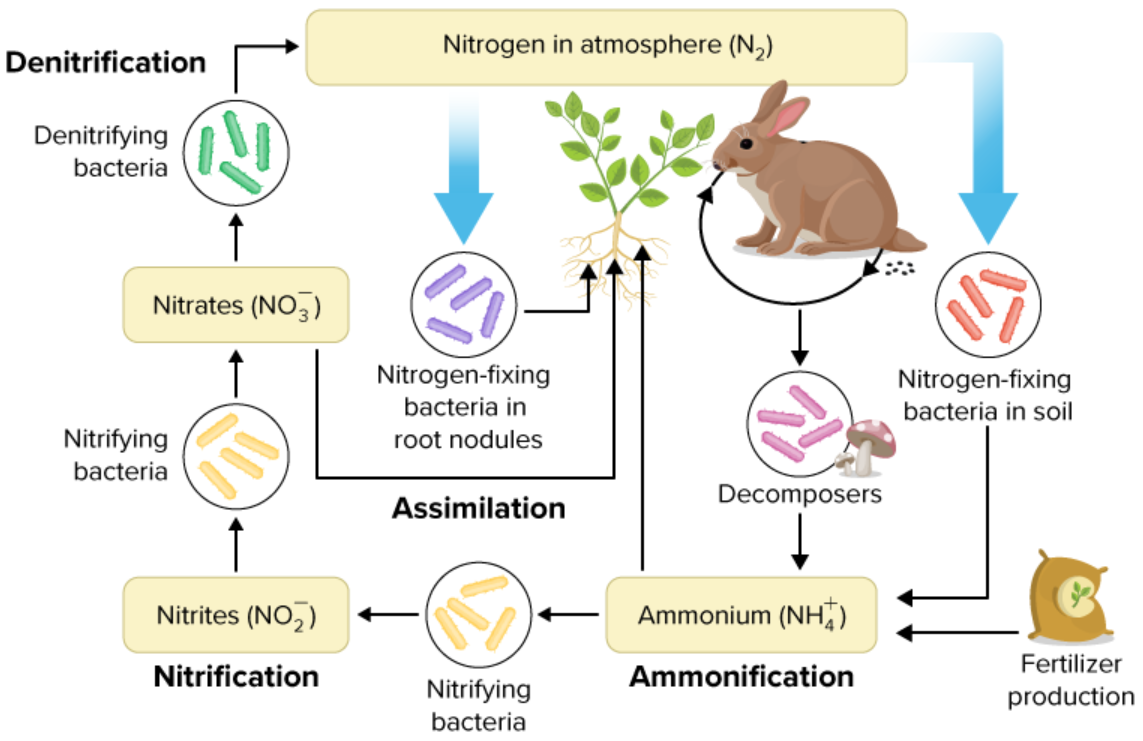
Bacteria are essential for converting atmospheric nitrogen (N₂) into forms usable by plants.
Key Processes and Bacterial Roles
- Nitrogen Fixation:
- Rhizobium: Symbiotic bacteria in legume root nodules
- Azotobacter, Clostridium: Free-living soil bacteria
- Converts N₂ → Ammonia (NH₃)
- Nitrification:
- Nitrosomonas: Converts ammonia → nitrites (NO₂⁻)
- Nitrobacter: Converts nitrites → nitrates (NO₃⁻)
- Nitrates are absorbed by plant roots
- Denitrification:
- Pseudomonas, Bacillus: Convert nitrates → N₂ gas
- Returns nitrogen to atmosphere
Importance of Bacteria to Humans
Beneficial Applications
- Agriculture:
- Nitrogen-fixing bacteria increase soil fertility
- Decomposers create humus and improve soil structure
- Food Production:
- Yogurt, cheese, vinegar (fermentation)
- Pickles, sauerkraut (lactic acid bacteria)
- Medicine & Biotechnology:
- Antibiotic production (e.g., streptomycin from Streptomyces)
- Insulin production via genetically modified E. coli
- Probiotics for digestive health
- Environmental Cleanup:
- Bioremediation: Bacteria break down oil spills, pesticides
- Sewage treatment: Bacteria digest organic waste
Harmful Effects of Bacteria
Pathogenic Bacteria
- Disease Examples:
- Cholera (Vibrio cholerae)
- Tuberculosis (Mycobacterium tuberculosis)
- Pneumonia (Streptococcus pneumoniae)
- Food poisoning (Salmonella, E. coli)
- Transmission: Air, water, food, contact, vectors
Other Negative Impacts
- Food Spoilage: Bacterial growth causes rotting and toxins
- Economic Damage: Crop diseases, livestock infections
Prevention and Control
- Sterilization (heat, chemicals)
- Antibiotics (penicillin, tetracycline)
- Vaccination (stimulates immunity)
- Proper hygiene and sanitation
Summary Table: Bacterial Features & Importance
| Feature | Description | Importance |
|---|---|---|
| Prokaryotic Cell | No nucleus, simple structure | Allows rapid reproduction and adaptation |
| Binary Fission | Asexual reproduction by cell division | Rapid population growth |
| Saprophytic Nutrition | Feeds on dead organic matter | Essential for decomposition and nutrient cycling |
| Nitrogen Fixation | Converts N₂ to ammonia (Rhizobium) | Makes nitrogen available to plants |
| Nitrification | Converts ammonia to nitrates (Nitrosomonas, Nitrobacter) | Produces plant-usable nitrogen forms |
| Denitrification | Converts nitrates to N₂ (Pseudomonas) | Returns nitrogen to atmosphere |
| Antibiotic Production | Some bacteria produce antimicrobial substances | Source of medicines to fight bacterial infections |
CSEC Exam Focus
Common Exam Questions
- Compare and contrast prokaryotic and eukaryotic cells
- Describe the role of bacteria in the nitrogen cycle (with named examples)
- Explain the importance of decomposer bacteria in an ecosystem
- Label a diagram of a bacterial cell
- Distinguish between autotrophic and heterotrophic nutrition in bacteria
Key Definitions to Memorize
Prokaryote
Organism lacking a true nucleus and membrane-bound organelles
Binary Fission
Asexual reproduction where a cell divides into two identical cells
Nitrogen Fixation
Conversion of atmospheric nitrogen to ammonia by bacteria
Saprophyte
Organism that feeds on dead organic matter
Interactive Learning Section
Question 1: Which bacterial structure is responsible for movement?
Question 2: What is the primary role of Rhizobium bacteria?
Conclusion: The Essential Microbes
Bacteria, though microscopic, are giants in their ecological impact. As prokaryotic organisms, they demonstrate remarkable adaptability and play indispensable roles in:
- Nutrient Recycling: Breaking down dead matter and returning elements to ecosystems
- The Nitrogen Cycle: Making atmospheric nitrogen available to living organisms
- Human Affairs: From agriculture and food production to medicine and biotechnology
CSEC Connection: Understanding bacteria is crucial for exam success and for appreciating the interconnectedness of life. Remember that while some bacteria cause disease, most are beneficial and essential for life on Earth.