
Are Viruses Alive?
Understanding Why Viruses Are Difficult to Classify and How They Reproduce Inside Host Cells
CSEC Biology | Characteristics of Living Things | Classification
The Great Biological Debate
Are viruses alive? This question has puzzled biologists for over a century. To answer it, we must examine the seven characteristics of living things (MRS GREN): Movement, Respiration, Sensitivity, Growth, Reproduction, Excretion, and Nutrition.
Viruses seem to exist in a grey area between living and non-living. They show some characteristics of life but lack others, making them one of the most fascinating topics in biology.
Drag each characteristic to show whether viruses display it!
Viruses CAN Do This
Viruses CANNOT Do This
What Is a Virus?
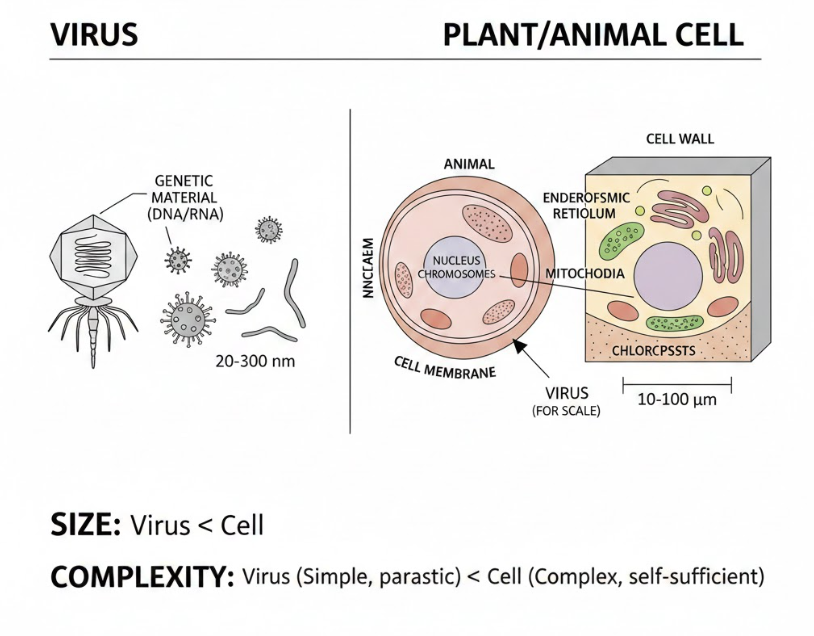
A virus is a microscopic, infectious agent that can only replicate inside the living cells of a host organism. They are non-cellular, meaning they lack a cell membrane, cytoplasm, and organelles.
Key Features:
- Size: 20-400 nanometers (100x smaller than bacteria)
- Structure: Simple – genetic material surrounded by protein coat
- Status: Obligate intracellular parasites
Common Examples:
Influenza Virus
Causes the flu; enveloped RNA virus
HIV
Human Immunodeficiency Virus; attacks immune system
Bacteriophage
Virus that infects bacteria; complex structure
Tobacco Mosaic Virus
First virus discovered; infects plants
Different virus shapes and sizes
Structure of a Virus
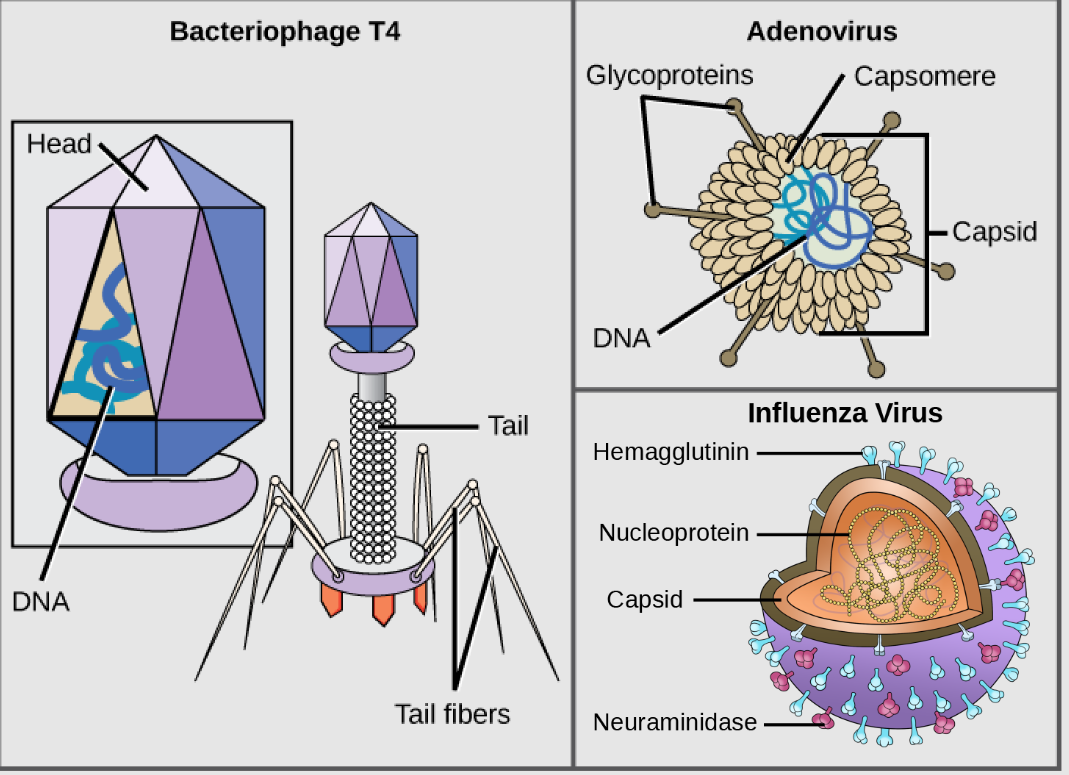
All viruses share a basic structure, though some have additional components:
- Genetic Material: DNA or RNA (never both) that carries instructions for replication
- Protein Coat (Capsid): Made of protein subunits called capsomeres; protects genetic material
- Envelope (in some viruses): Lipid bilayer membrane stolen from host cell; may contain glycoprotein spikes
Click the buttons to build a virus and see each component!
Virus structure: Genetic material is always present. Add protein coat and envelope to see complete virus.
How Viruses Compare to Living Things
Let’s examine viruses against the characteristics of life (MRS GREN):
| Characteristic | Viruses | Living Organisms |
|---|---|---|
| Cellular Structure | Non-cellular | Made of cells |
| Reproduction | Only inside host cell | Independent (cell division) |
| Metabolism | No energy production | Respiration & nutrition |
| Growth | Assembled fully formed | Increases in size |
| Response to Stimuli | Only through host | Direct response |
| Genetic Material | DNA or RNA | DNA and RNA |
Why Viruses Are Difficult to Classify
Viruses challenge our traditional classification systems. They are not placed in any of the five kingdoms because:
- They are not made of cells
- They cannot carry out independent metabolism
- They exist in a state of “biological suspended animation” outside host cells
See where viruses fit (or don’t fit) in the tree of life!
Not in any kingdom
Viruses exist outside the traditional five-kingdom system because they lack cellular structure and independent metabolism.
How Viruses Reproduce Inside Host Cells
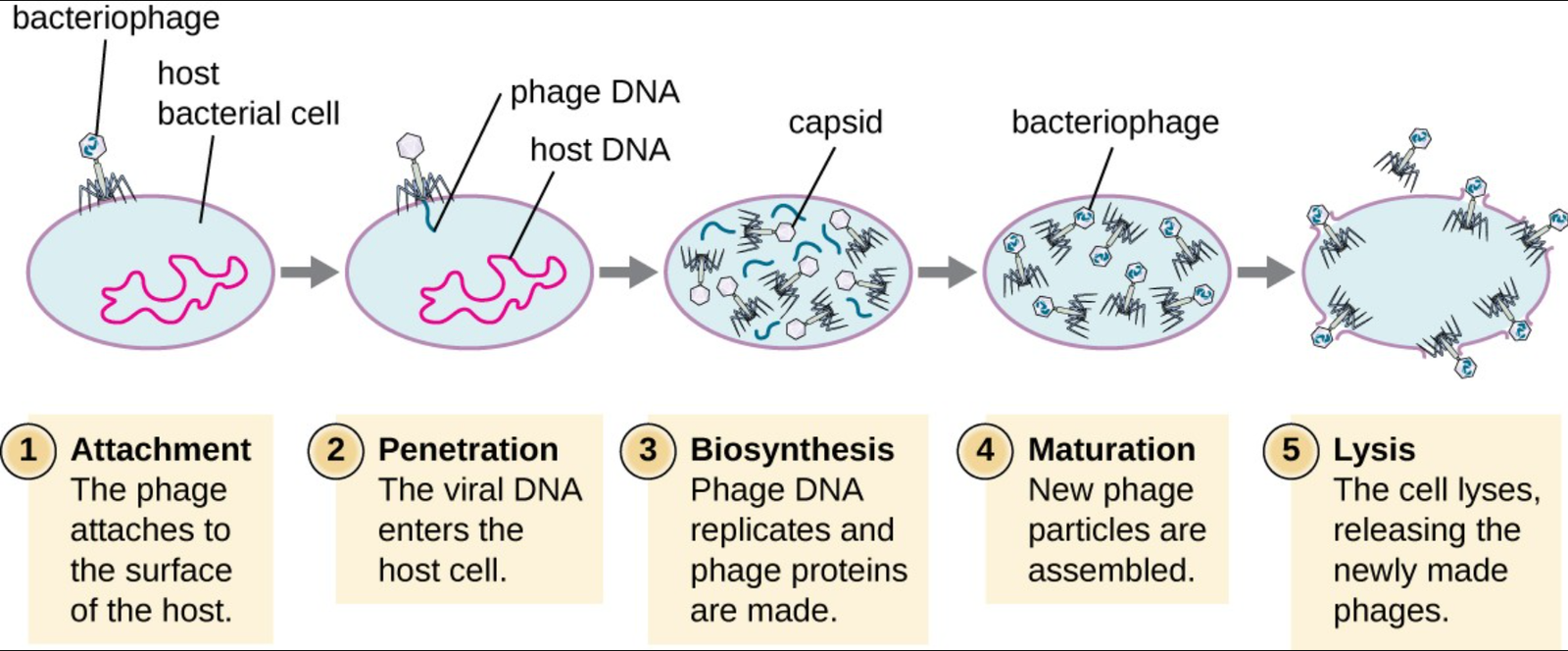
Viruses cannot reproduce on their own. They must invade a host cell and hijack its machinery. This process is called the lytic cycle.
Click each stage to see the viral replication process!
DNA, Ribosomes,
Energy
1. Attachment
Viral proteins attach to specific receptor sites on the host cell membrane.
Key Stages of the Lytic Cycle:
- Attachment: Virus binds to host cell receptors
- Entry: Viral genetic material enters host cell
- Replication: Host cell machinery copies viral genetic material and makes viral proteins
- Assembly: New virus particles are assembled
- Release: Host cell bursts (lyses), releasing new viruses
Virus replication cycle in a host cell
Why Viruses Are Important to Study
Disease & Health
Understanding viruses helps combat diseases like COVID-19, HIV, influenza, and Ebola
Vaccines
Viral knowledge is essential for vaccine development and understanding immunity
Biotechnology
Viruses are used in gene therapy and genetic engineering
Evolution
Viruses drive evolution through horizontal gene transfer
📝 CSEC Exam Focus
Common Exam Questions:
- “State two reasons why viruses are considered non-living.” (2 marks)
- “Describe the structure of a virus.” (3 marks)
- “Explain why viruses are not classified in any of the five kingdoms.” (2 marks)
- “Outline the stages of viral replication in a host cell.” (5 marks)
Key Definitions to Memorize:
- Virus: A non-cellular infectious particle that reproduces only inside host cells
- Capsid: Protein coat surrounding viral genetic material
- Lytic Cycle: Viral replication cycle that results in host cell destruction
- Obligate Intracellular Parasite: Organism that must live inside a host cell
Review & CSEC Practice
Answer quickly! Test your knowledge for the CSEC exam.
Quiz Complete!
Think & Discuss
Are viruses alive? Write your argument:
Based on what you’ve learned, write a short paragraph (3-4 sentences) arguing either:
- FOR: Viruses should be considered living organisms
- AGAINST: Viruses should NOT be considered living organisms
Support your argument with at least two pieces of evidence from this article.