
Introduction to the Five-Kingdom System
Why Biologists Use the Prokaryote, Protoctist, Fungus, Plant, and Animal Classification
What is Biological Classification?
Biological classification is the scientific method of organizing living organisms into groups based on their similarities and evolutionary relationships. Think of it as a giant “filing system” for all life on Earth!
Why Do We Classify Organisms?
- Organization: Makes studying millions of species manageable
- Identification: Helps scientists identify new organisms
- Understanding Relationships: Shows evolutionary connections
- Prediction: Allows predictions about unknown characteristics
- Communication: Provides a universal language for scientists worldwide
Explore how classification systems have evolved over time!
350 BC: Aristotle
First classification system: Plants vs. Animals
1735: Linnaeus
Two-kingdom system: Plantae and Animalia
1969: Whittaker
Five-kingdom system (what we study today!)
Today: Three Domains
Bacteria, Archaea, Eukarya (more advanced)
Hierarchy of biological classification
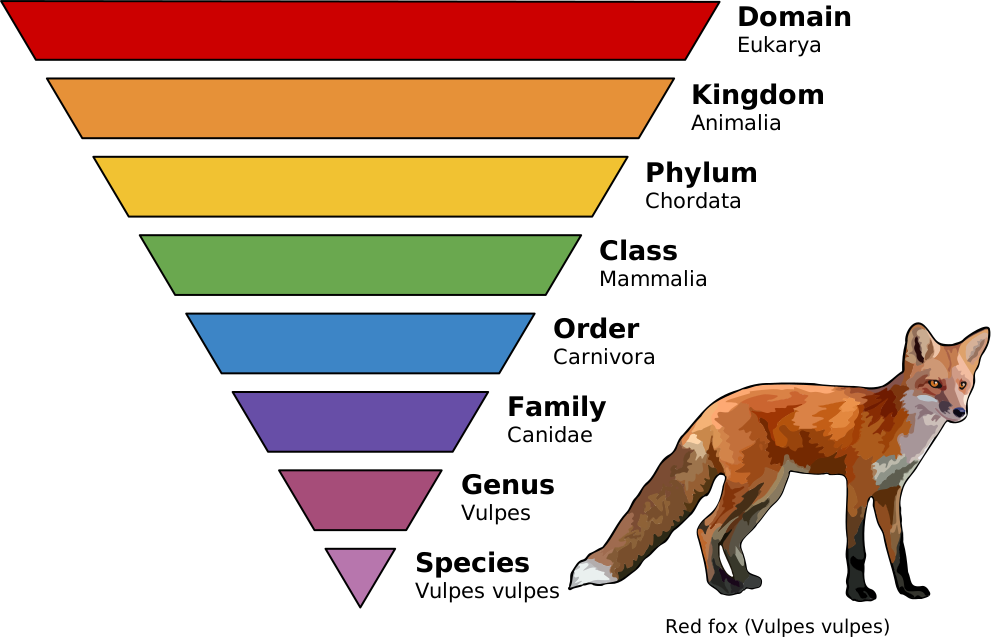
(Remember: King Philip Came Over For Good Spaghetti!)
The Five-Kingdom System
In 1969, biologist Robert Whittaker proposed the Five-Kingdom System, which classifies all organisms based on:
Cell Structure
Prokaryotic (no nucleus) vs. Eukaryotic (has nucleus)
Cell Number
Unicellular (one cell) vs. Multicellular (many cells)
Nutrition
Autotrophic (makes food) vs. Heterotrophic (consumes food)
The Five Kingdoms at a Glance
Let’s meet the five kingdoms! Each has unique characteristics that help biologists identify where organisms belong.
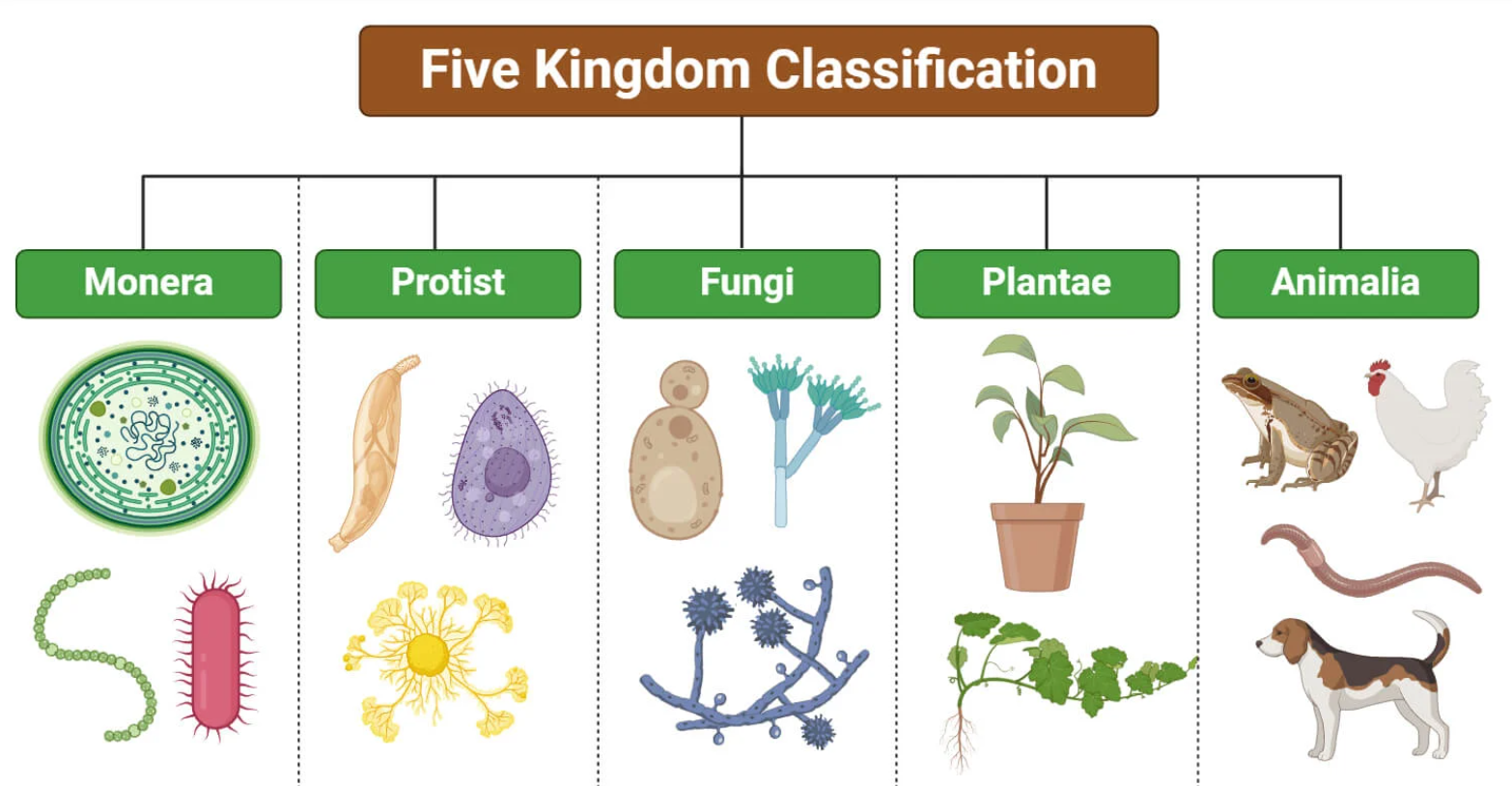
Visual flowchart showing kingdom relationships and characteristics
Prokaryote Kingdom
Simple, microscopic, no nucleus
Protoctist Kingdom
Mostly unicellular, diverse
Fungus Kingdom
Chitin cell walls, decomposers
Plant Kingdom
Photosynthetic, cellulose walls
Animal Kingdom
Mobile, no cell walls, consumers
Classification Criteria
| Criterion | What It Means | Examples |
|---|---|---|
| Cell Type | Prokaryotic (no nucleus) or Eukaryotic (has nucleus) | Prokaryotes: Bacteria; Eukaryotes: All other kingdoms |
| Cell Number | Unicellular (one cell) or Multicellular (many cells) | Unicellular: Bacteria, Protoctists; Multicellular: Plants, Animals, Fungi |
| Nutrition | Autotrophic (makes own food) or Heterotrophic (eats others) | Autotrophic: Plants; Heterotrophic: Animals, Fungi |
| Cell Wall | Presence and composition of cell wall | Plants: Cellulose; Fungi: Chitin; Animals: None |
Prokaryote Kingdom (Monera)
The Simplest Life Forms
Prokaryotes are the oldest and most primitive organisms on Earth. They’re microscopic and have a simple structure.
Structure of a bacterial cell

Labeled Bacterial Cell Diagram
Showing cell wall, cytoplasm, DNA (nucleoid), ribosomes, flagella
Key Characteristics
No True Nucleus
DNA floats freely in cytoplasm as a nucleoid (not enclosed in a nuclear membrane)
Microscopic Size
Typically 1-10 micrometers (1000x smaller than a plant cell!)
Rapid Reproduction
Binary fission – can divide every 20 minutes under ideal conditions
Types of Prokaryotes
Bacteria
Decomposers, pathogens, nitrogen fixers
Cyanobacteria
Blue-green algae, photosynthetic
Beneficial Roles:
- Decomposition: Break down dead organisms and waste
- Nitrogen Fixation: Convert atmospheric nitrogen to plant-usable forms
- Digestion: Gut bacteria help digest food and produce vitamins
- Food Production: Used in yogurt, cheese, and fermentation
Harmful Effects:
- Disease: Cause illnesses like tuberculosis, cholera
- Food Spoilage: Cause food to rot and become unsafe
CSEC Exam Tip: Remember that ALL prokaryotes are unicellular, but NOT all unicellular organisms are prokaryotes (some protoctists are also unicellular but eukaryotic).
Protoctist Kingdom (Protista)
The “Miscellaneous” Kingdom
Protoctists are mostly unicellular eukaryotes that don’t fit into the other kingdoms. They’re incredibly diverse!
Common protoctists under microscope

A sampling of protists, composed of images from Wikimedia Commons. Clockwise from top left: red algae (Chondrus crispus); brown algae (Giant Kelp); ciliate (Frontonia); golden algae (Dinobryon); Foraminifera (Radiolaria); parasitic flagellate (Giardia muris); pathogenic amoeba (Acanthamoeba); amoebozoan slime mold (Fuligo septica)
Key Characteristics
- Eukaryotic: Have a true nucleus and membrane-bound organelles
- Mostly Unicellular: Single-celled but more complex than bacteria
- Diverse Nutrition: Some are autotrophic, some heterotrophic
- Aquatic: Most live in water or moist environments
Major Groups of Protoctists
Amoeboid Protozoans
Move using pseudopodia (false feet)
Ciliated Protozoans
Move using hair-like cilia
Flagellated Protozoans
Move using whip-like flagella
Algae
Plant-like, photosynthetic
Important Protoctists to Know
| Organism | Type | Movement | Nutrition | Importance |
|---|---|---|---|---|
| Amoeba | Protozoan | Pseudopodia | Heterotrophic | Causes amoebic dysentery |
| Paramecium | Protozoan | Cilia | Heterotrophic | Common pond organism |
| Euglena | Flagellate | Flagellum | Both (mixotrophic) | Has chloroplasts like plants |
| Spirogyra | Algae | None (floats) | Autotrophic | Forms pond scum, photosynthetic |
- Malaria Connection: Plasmodium (causes malaria) is a protoctist, not a bacteria!
- Oxygen Production: Algae produce about 50% of Earth’s oxygen
- Size Range: From microscopic diatoms to giant kelp (seaweed) that can be 60m long!
- Economic Importance: Agar (from algae) used in labs, food, and cosmetics
Fungus Kingdom (Fungi)
Nature’s Recyclers
Fungi are decomposers that break down dead organic matter. They’re more closely related to animals than plants!
Structure of fungi and hyphae

Fungal hyphae cells: (1) Hyphal wall. (2) Septum. (3) Mitochondrion. (4) Vacuole. (5) Ergosterol crystal. (6) Ribosome. (7) Nucleus. (8) Endoplasmic reticulum. (9) Lipid body. (10) Plasma membrane. (11) Spitzenkörper. (12) Golgi apparatus
Key Characteristics
Chitin Cell Walls
Cell walls made of chitin (same material as insect exoskeletons)
Saprophytic Nutrition
Absorb nutrients from dead or decaying matter (decomposers)
Spore Reproduction
Reproduce via spores (like tiny seeds) that spread through air
Types of Fungi
Mushrooms
Fruiting bodies of fungi, visible reproductive structures
Yeast
Unicellular fungi used in baking and brewing
Mold
Fuzzy growth on decaying matter
Lichens
Symbiotic relationship between fungi and algae
Fungal Structure
- Hyphae: Thread-like filaments that make up the fungus body
- Mycelium: Mass of hyphae (main body of the fungus)
- Fruiting Body: Reproductive structure (what we call a mushroom)
- Spores: Microscopic reproductive cells (like plant seeds)
Beneficial Fungi
- Decomposition: Recycle nutrients back to soil
- Food: Mushrooms, truffles, yeast for bread
- Medicine: Penicillin (first antibiotic)
- Industry: Yeast for brewing and baking
Harmful Fungi
- Disease: Athlete’s foot, ringworm
- Crop Damage: Rusts, smuts, mildews
- Food Spoilage: Mold on bread, fruit
- Poisonous: Some wild mushrooms deadly
CSEC Exam Tip: Remember that fungi have cell walls like plants, but their walls are made of chitin (not cellulose) and they cannot photosynthesize.
Plant Kingdom (Plantae)
Earth’s Primary Producers
Plants are multicellular eukaryotes that produce their own food through photosynthesis. They form the base of most food chains.
Plant cell structure and types of plants

The image is of a typical plant cell; reference being the book Molecular Cell Biology by James Darnell, Harvey Lodish and David Baltimore.
Key Characteristics
Autotrophic
Make own food via photosynthesis: CO₂ + H₂O → Glucose + O₂
Cellulose Walls
Rigid cell walls made of cellulose for support
Chloroplasts
Contain chlorophyll for capturing sunlight energy
Vacuoles
Large central vacuole for storage and support
Major Plant Groups
| Group | Characteristics | Examples | Vascular Tissue |
|---|---|---|---|
| Bryophytes | Non-vascular, small, no true roots | Mosses, liverworts | ❌ No |
| Pteridophytes | Vascular, reproduce by spores | Ferns, horsetails | ✅ Yes |
| Gymnosperms | Vascular, naked seeds, cones | Pine trees, conifers | ✅ Yes |
| Angiosperms | Vascular, flowering plants, fruits | Fruit trees, grasses | ✅ Yes |
Plant Cell Structure
Cell Wall
Rigid outer layer of cellulose for support and protection
Chloroplasts
Contain chlorophyll for photosynthesis
Vacuole
Large storage sac for water, nutrients, and waste
Nucleus
Controls cell activities, contains DNA
Desert Plants
Thick stems, reduced leaves, deep roots
Aquatic Plants
Air spaces, floating leaves, flexible stems
Evergreen Trees
Needle leaves, thick bark, conical shape
Flowering Plants
Bright flowers, nectar, specific pollinators
CSEC Exam Tip: Remember that plants are the only kingdom that is always autotrophic. If an organism makes its own food via photosynthesis and has cellulose cell walls, it’s a plant!
Animal Kingdom (Animalia)
The Consumers
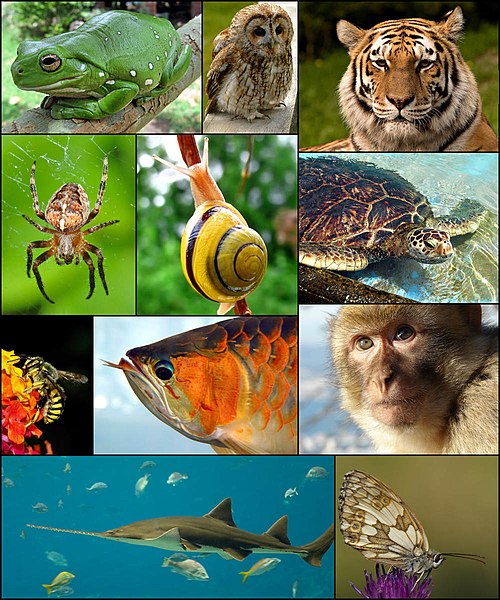
Animals are multicellular eukaryotes that must consume other organisms for food. They’re the most diverse kingdom in terms of body forms and habitats.
Diversity of animals
Key Characteristics
No Cell Walls
Cells have only a cell membrane, allowing flexibility and movement
Heterotrophic
Must consume other organisms for food
Motile
Most can move at some life stage (locomotion)
Nervous Systems
Have nerve cells for coordination and response
Major Animal Groups
| Group | Characteristics | Examples | Vertebrate/Invertebrate |
|---|---|---|---|
| Arthropods | Jointed legs, exoskeleton | Insects, spiders, crabs | Invertebrate |
| Mollusks | Soft body, often with shell | Snails, octopus, clams | Invertebrate |
| Fish | Gills, scales, aquatic | Salmon, shark, goldfish | Vertebrate |
| Amphibians | Moist skin, life in water & land | Frogs, toads, salamanders | Vertebrate |
| Reptiles | Scales, leathery eggs | Snakes, lizards, turtles | Vertebrate |
| Birds | Feathers, beaks, lay eggs | Eagles, sparrows, penguins | Vertebrate |
| Mammals | Hair/fur, mammary glands | Humans, whales, bats | Vertebrate |
Vertebrates vs. Invertebrates
Vertebrates (5%)
Have a backbone or spinal column
Invertebrates (95%)
No backbone – majority of animals!
Which animal belongs to which group?
Animals to Classify:
1. Earthworm
2. Frog
3. Butterfly
4. Human
5. Snail
Answers will appear here…
CSEC Exam Tip: Remember that animals are the only kingdom that is always heterotrophic and never has cell walls. If an organism eats other organisms and has no cell walls, it’s an animal!
Five-Kingdom Comparison Table
Side-by-Side Comparison
Use this table to quickly compare the characteristics of each kingdom for your CSEC exams:
| Kingdom | Cell Type | Cell Number | Cell Wall | Nutrition | Examples |
|---|---|---|---|---|---|
| Prokaryote (Monera) | Prokaryotic | Unicellular | Yes (peptidoglycan) | Autotrophic or Heterotrophic | Bacteria, Cyanobacteria |
| Protoctist (Protista) | Eukaryotic | Mostly Unicellular | Some have (various) | Autotrophic or Heterotrophic | Amoeba, Euglena, Algae |
| Fungus (Fungi) | Eukaryotic | Mostly Multicellular | Yes (chitin) | Heterotrophic (Saprophytic) | Mushrooms, Yeast, Mold |
| Plant (Plantae) | Eukaryotic | Multicellular | Yes (cellulose) | Autotrophic (Photosynthetic) | Trees, Ferns, Mosses |
| Animal (Animalia) | Eukaryotic | Multicellular | No | Heterotrophic | Insects, Fish, Mammals |
Quick Memory Aids
Prokaryotes = Simple
No nucleus, microscopic, oldest life forms
Protoctists = Diverse
Mostly unicellular, “catch-all” kingdom
Fungi = Decomposers
Chitin walls, absorb food, spore reproduction
Plants = Producers
Cellulose walls, photosynthesis, always autotrophic
Animals = Consumers
No cell walls, heterotrophic, most motile
Match each characteristic to the correct kingdom!
Prokaryote
Protoctist
Fungus
Plant
Animal
Why Classification Matters
Beyond Just Organizing
Classification isn’t just about putting organisms into boxes – it has practical applications in many fields:
Medicine
Identifying disease-causing organisms helps develop treatments and vaccines
Agriculture
Understanding plant and pest relationships improves crop yields
Conservation
Knowing species relationships helps protect endangered organisms
Research
Provides framework for studying evolution and biodiversity
Real-World Applications
Food Safety
Identifying food-spoiling bacteria and fungi prevents illness
Biotechnology
Using bacteria (prokaryotes) to produce insulin and other medicines
Environmental Cleanup
Using bacteria and fungi to break down pollutants (bioremediation)
Forensics
Identifying organisms at crime scenes can provide evidence
Case Study: Penicillin Discovery
In 1928, Alexander Fleming noticed that mold (fungus) was killing bacteria (prokaryotes) in his lab. Because he could classify these organisms:
- He knew the mold was a fungus (Penicillium)
- He knew the bacteria were prokaryotes (Staphylococcus)
- This led to the discovery of penicillin, the first antibiotic
Lesson: Classification helps scientists make connections between different organisms!
Evolutionary Insights
The Five-Kingdom System shows evolutionary relationships:
- Prokaryotes → Protoctists: Development of the nucleus
- Protoctists → Plants/Fungi/Animals: Development of multicellularity
- Fungi and Animals: More closely related to each other than to plants
- Plants: Evolved from photosynthetic protoctists (algae)
CSEC Exam Preparation
Common Exam Questions
These are the types of classification questions you’ll see on your CSEC Biology exam:
Quiz Complete!
Key Definitions to Memorize
Classification
Grouping organisms based on similarities
Prokaryotic
Cells without a nucleus
Eukaryotic
Cells with a true nucleus
Autotrophic
Makes own food (photosynthesis/chemosynthesis)
Heterotrophic
Consumes other organisms for food
Saprophytic
Absorbs nutrients from dead matter (fungi)
Exam Answer Tips
| Question Type | What to Do | Example |
|---|---|---|
| “State the kingdom” | Give one-word answer (e.g., “Fungus”) | Mushroom → Fungus |
| “Give TWO characteristics” | List clear features from table | Plant: cellulose walls, photosynthetic |
| “Compare and contrast” | Use a table or bullet points | Plants vs. Fungi: walls (cellulose vs. chitin) |
| “Explain why” | Give biological reason | Why fungi aren’t plants: no chlorophyll |
- Mistake: Saying bacteria are plants (they’re prokaryotes!)
- Mistake: Thinking all fungi are mushrooms (yeast is unicellular)
- Mistake: Forgetting that protoctists are eukaryotic
- Mistake: Saying animals can be autotrophic (always heterotrophic)
- Tip: If it has chloroplasts → Plant or Algae (protoctist)
- Tip: If it has no cell walls → Always Animal
Interactive Learning Section
Quick Check Questions
Questions:
1. Which kingdom has no nucleus?
2. What makes fungi different from plants?
3. Name a unicellular fungus.
4. Which protoctist can photosynthesize?
5. What cell wall material do plants have?
Click “Show Answers” to check
Did You Know? Fascinating Facts
Fungi are Closer to Animals
DNA evidence shows fungi are more closely related to animals than plants!
Giant Bacteria
Most bacteria are microscopic, but Thiomargarita namibiensis can be seen with the naked eye (0.75mm)!
Plant Communication
Some plants release chemicals to warn nearby plants of insect attacks!
Animal Without Mitochondria
Monocercomonoides is the only known animal without mitochondria!
Classification Challenge
Given these characteristics, identify which kingdom each organism belongs to:
Prokaryote
Protoctist
Fungus
Plant
Animal
Think & Apply
Scenario 1: New Discovery
A scientist discovers a new organism: multicellular, has chlorophyll but no cell walls. Which kingdom? Why?
Scenario 2: Food Poisoning
People get sick from spoiled meat. Is it more likely caused by bacteria (prokaryote) or fungi? Explain.
Scenario 3: Pond Life
You find green floating material in a pond. How could you determine if it’s algae (protoctist) or duckweed (plant)?
Conclusion & Further Study
Key Takeaways
The Five-Kingdom System provides a clear framework for understanding life’s diversity. Remember these essential points:
Prokaryotes = Simple
No nucleus, oldest life forms, incredibly abundant
Protoctists = Diverse
Mostly unicellular eukaryotes, “leftover” kingdom
Fungi = Recyclers
Decomposers with chitin walls, vital for nutrient cycling
Plants = Producers
Photosynthetic autotrophs, base of most food chains
Animals = Consumers
Heterotrophs without cell walls, most diverse in form
Design your own organism and classify it!
Your Organism:
• Unicellular
• Has a nucleus
• Photosynthetic
• Lives in ocean
• Moves with flagella
Classification will appear here…
Beyond the Five Kingdoms
Modern classification has evolved since Whittaker’s system. For further study:
- Three Domain System: Bacteria, Archaea, Eukarya (more accurate evolutionary tree)
- Six Kingdom System: Splits prokaryotes into Eubacteria and Archaebacteria
- Molecular Phylogenetics: Using DNA to determine evolutionary relationships
- Cladistics: Classification based on common ancestry rather than just characteristics
Why This Matters for CSEC Biology
Foundation for Ecology
Understanding kingdoms helps study ecosystems and food webs
Basis for Evolution
Classification shows evolutionary relationships between organisms
Practical Applications
Used in medicine, agriculture, conservation, and biotechnology
Scientific Thinking
Develops skills in observation, comparison, and organization
CSEC Mastery Challenge
Choose any organism around you and write a complete classification:
Kingdom → Characteristics → Reason for Classification
“Classification is the foundation upon which the understanding of life is built. Master it, and you hold the key to biology.”