
CSEC Mathematics Vectors Past Paper questions with worked solutions
In the diagram below \(OPQL\) is a parallelogram.
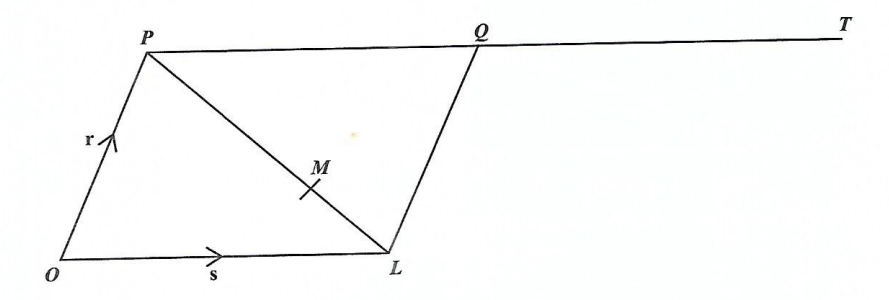
\(\overrightarrow{OP} = \mathbf{r}\) and \(\overrightarrow{OL} = \mathbf{s}\).
\(T\) is the point such that \(\overrightarrow{PQ} = \overrightarrow{QT}\).
The point \(M\) divides \(PL\) in the ratio \(2:1\).
(i) Find, in terms of \(\mathbf{r}\) and \(\mathbf{s}\),
(ii) Prove that the points \(O, M\) and \(T\) are collinear. 3 marks
Click to reveal Worked Solutions
Using the triangle law of vectors:
\(\overrightarrow{PL} = \overrightarrow{PO} + \overrightarrow{OL}\)
Since \(\overrightarrow{PO} = -\overrightarrow{OP}\):
\(\overrightarrow{PL} = -\mathbf{r} + \mathbf{s}\) or \(\mathbf{s} – \mathbf{r}\)
\(M\) divides \(PL\) in ratio \(2:1\), so \(\overrightarrow{PM} = \frac{2}{3}\overrightarrow{PL}\).
\(\overrightarrow{OM} = \overrightarrow{OP} + \overrightarrow{PM}\)
\(\overrightarrow{OM} = \mathbf{r} + \frac{2}{3}(\mathbf{s} – \mathbf{r})\)
\(\overrightarrow{OM} = \mathbf{r} + \frac{2}{3}\mathbf{s} – \frac{2}{3}\mathbf{r}\)
\(\overrightarrow{OM} = \mathbf{\frac{1}{3}r + \frac{2}{3}s}\)
To prove \(O, M,\) and \(T\) are collinear, we show \(\overrightarrow{OM} = k\overrightarrow{OT}\).
1. Find \(\overrightarrow{OT}\):
In parallelogram \(OPQL\), \(\overrightarrow{PQ} = \overrightarrow{OL} = \mathbf{s}\).
Given \(\overrightarrow{PQ} = \overrightarrow{QT}\), then \(\overrightarrow{QT} = \mathbf{s}\).
\(\overrightarrow{OT} = \overrightarrow{OP} + \overrightarrow{PQ} + \overrightarrow{QT} = \mathbf{r} + \mathbf{s} + \mathbf{s} = \mathbf{r} + 2\mathbf{s}\)
2. Compare vectors:
\(\overrightarrow{OM} = \frac{1}{3}\mathbf{r} + \frac{2}{3}\mathbf{s} = \frac{1}{3}(\mathbf{r} + 2\mathbf{s})\)
\(\overrightarrow{OM} = \frac{1}{3}\overrightarrow{OT}\)
Conclusion: Since \(\overrightarrow{OM}\) is a scalar multiple of \(\overrightarrow{OT}\) and both vectors share the common point \(O\), the points \(O, M,\) and \(T\) lie on the same straight line (collinear).
(a) The diagram below shows quadrilateral \(OLMN\), in which \(O\) is the origin, \(\overrightarrow{OL} = 4\mathbf{y}\), \(\overrightarrow{OM} = 6\mathbf{z}\) and \(\overrightarrow{ON} = 2\mathbf{x}\).
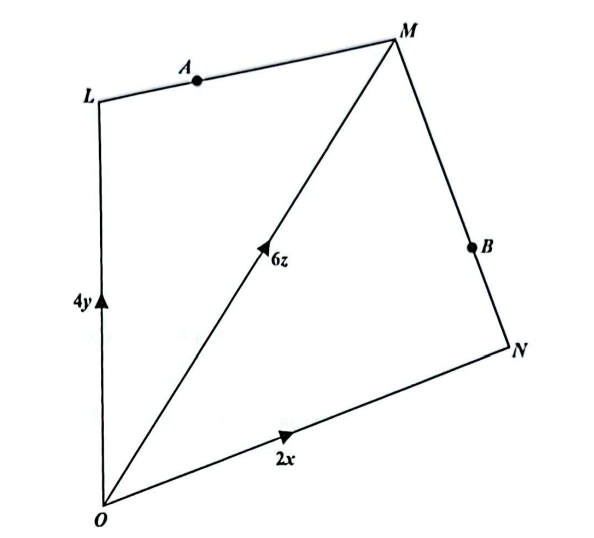
The point \(A\) lies on \(LM\) such that \(LA : AM = 1 : 2\) and the point \(B\) lies on \(MN\) such that \(MB : BN = 2 : 1\).
(i) Express, in its simplest form, vector \(\vec{MN}\) in terms of \(x\) and \(z\). 1 mark
(ii)
(iii) Based on your results in Part (ii), state TWO geometric properties relating \(LN\) to \(AB\). 2 marks
Click to reveal Worked Solutions
To find \(\vec{MN}\), we use the triangle law:
\(\vec{MN} = \vec{MO} + \vec{ON}\)
\(\vec{MO} = -\vec{OM} = -6\mathbf{z}\), \(\vec{ON} = 2\mathbf{x}\)
So, \(\vec{MN} = -6\mathbf{z} + 2\mathbf{x} = 2\mathbf{x} – 6\mathbf{z}\)
\(\vec{LN} = \vec{LO} + \vec{ON}\)
\(\vec{LO} = -\vec{OL} = -4\mathbf{y}\), \(\vec{ON} = 2\mathbf{x}\)
So, \(\vec{LN} = -4\mathbf{y} + 2\mathbf{x} = 2\mathbf{x} – 4\mathbf{y}\)
First, find \(\vec{LA}\): since \(LA : AM = 1 : 2\), then \(LA = \frac{1}{3}LM\)
\(\vec{LM} = \vec{LO} + \vec{OM} = -4\mathbf{y} + 6\mathbf{z}\)
So, \(\vec{LA} = \frac{1}{3}(-4\mathbf{y} + 6\mathbf{z}) = -\frac{4}{3}\mathbf{y} + 2\mathbf{z}\)
Next, find \(\vec{AB}\):
\(\vec{AB} = \vec{AM} + \vec{MB}\)
\(\vec{AM} = \vec{LM} – \vec{LA} = ( -4\mathbf{y} + 6\mathbf{z} ) – ( -\frac{4}{3}\mathbf{y} + 2\mathbf{z} )\)
\(\vec{AM} = -\frac{8}{3}\mathbf{y} + 4\mathbf{z}\)
For \(\vec{MB}\), since \(MB : BN = 2 : 1\), then \(MB = \frac{2}{3}MN\)
\(\vec{MN} = 2\mathbf{x} – 6\mathbf{z}\), so \(\vec{MB} = \frac{2}{3}(2\mathbf{x} – 6\mathbf{z}) = \frac{4}{3}\mathbf{x} – 4\mathbf{z}\)
Therefore, \(\vec{AB} = \vec{AM} + \vec{MB} = -\frac{8}{3}\mathbf{y} + 4\mathbf{z} + \frac{4}{3}\mathbf{x} – 4\mathbf{z} = \frac{4}{3}\mathbf{x} – \frac{8}{3}\mathbf{y}\)
Factor out \(\frac{2}{3}\):
\(\vec{AB} = \frac{2}{3}(2\mathbf{x} – 4\mathbf{y})\)
From Part (ii), we found:
\(\vec{LN} = 2\mathbf{x} – 4\mathbf{y}\)
\(\vec{AB} = \frac{2}{3}(2\mathbf{x} – 4\mathbf{y}) = \frac{2}{3}\vec{LN}\)
Geometric Properties:
- AB is parallel to LN because they are scalar multiples of the same vector.
- AB is \(\frac{2}{3}\) the length of LN, so AB is shorter than LN and lies along the same direction.
The diagram below shows pentagon \(OABCD\), in which:
- \(OA\) is parallel to \(DC\)
- \(AB\) is parallel to \(OD\)
- \(\vec{OA} = \mathbf{a}\), \(\vec{AB} = \mathbf{b}\)
- \(OD = 2AB\), \(OA = 2DC\)
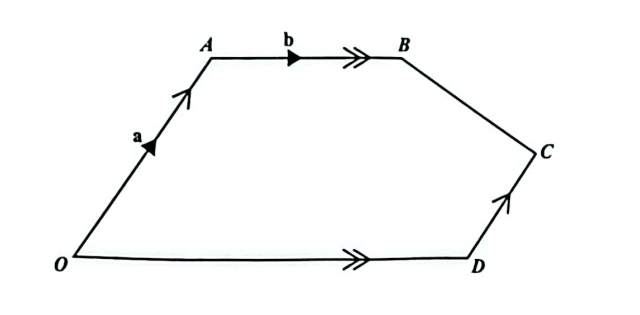
(i) Find, in terms of \(\mathbf{a}\) and \(\mathbf{b}\), in its simplest form:
- \(\vec{AD}\) 1 mark
- \(\vec{BC}\) 2 marks
(iii) State the conclusion about vector \(\vec{AD}\) and vector \(\vec{BC}\) that can be drawn from your responses in (i) and (ii). 1 mark
Click to reveal Worked Solutions
Use the direct vector path from A to D:
\[ \vec{AD} = \vec{AO} + \vec{OD} \] You are given:
\[ \vec{OA} = \mathbf{a} \quad\Rightarrow\quad \vec{AO} = -\mathbf{a} \] \[ \vec{AB} = \mathbf{b}, \quad OD = 2AB \Rightarrow \vec{OD} = 2\mathbf{b} \] Substitute into the path equation:
\[ \vec{AD} = -\mathbf{a} + 2\mathbf{b} \] Final answer: \[ \boxed{\vec{AD} = -\mathbf{a} + 2\mathbf{b}} \]
Use the path \(B \rightarrow C\):
\[ \vec{BC} = \vec{BO} + \vec{OC} \] First:
\[ \vec{BO} = -(\vec{OA} + \vec{AB}) = -(\mathbf{a} + \mathbf{b}) \] Since \(OA = 2DC\):
\[ \vec{DC} = \frac{1}{2}\mathbf{a} \] And:
\[ \vec{OC} = \vec{OD} + \vec{DC} = 2\mathbf{b} + \frac{1}{2}\mathbf{a} \] Now compute:
\[ \vec{BC} = -(\mathbf{a} + \mathbf{b}) + \left(2\mathbf{b} + \frac{1}{2}\mathbf{a}\right) \] Combine like terms:
\[ \vec{BC} = -\frac{1}{2}\mathbf{a} + \mathbf{b} \] Final answer: \[ \boxed{\vec{BC} = -\frac{1}{2}\mathbf{a} + \mathbf{b}} \]
From the results:
\[ \vec{AD} = -\mathbf{a} + 2\mathbf{b} \] \[ \vec{BC} = -\frac{1}{2}\mathbf{a} + \mathbf{b} \] Notice:
\[ \vec{AD} = 2\vec{BC} \] Therefore:
- \(\vec{AD}\) is parallel to \(\vec{BC}\).
- \(\vec{AD}\) is twice the magnitude of \(\vec{BC}\) and points in the same direction.
In the diagram below, \(O\) is the origin, \(OE = 2EF\), and \(M\) is the midpoint of \(EG\).
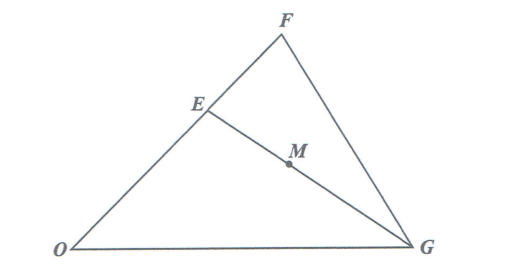
\(\vec{OG} = \mathbf{c}\) and \(\vec{OF} = \mathbf{d}\)
Find, in terms of \(\mathbf{c}\) and \(\mathbf{d}\), in its simplest form:
- (i) \(\vec{FG}\) 1 mark
- (ii) \(\vec{EG}\) 2 marks
- (iii) \(\vec{OM}\) 2 marks
Click to reveal Worked Solutions
Use the simple vector path from \(F \rightarrow G\):
\[ \vec{FG} = \vec{FO} + \vec{OG} \] You are given:
\[ \vec{OF} = \mathbf{d} \quad\Rightarrow\quad \vec{FO} = -\mathbf{d} \] \[ \vec{OG} = \mathbf{c} \] Substitute:
\[ \vec{FG} = -\mathbf{d} + \mathbf{c} \] Final answer:
\[ \boxed{\vec{FG} = \mathbf{c} – \mathbf{d}} \]
Use the path from \(E \rightarrow F \rightarrow G\):
\[ \vec{EG} = \vec{EF} + \vec{FG} \] From the ratio \(OE = 2EF\):
\[ \vec{OE} = 2\vec{EF} \quad\Rightarrow\quad \vec{EF} = \frac{1}{2}\vec{OE} \] Earlier we found:
\[ \vec{OE} = \frac{2}{3}\mathbf{d} \quad\Rightarrow\quad \vec{EF} = \frac{1}{2}\left(\frac{2}{3}\mathbf{d}\right) = \frac{1}{3}\mathbf{d} \] From Part (i):
\[ \vec{FG} = \mathbf{c} – \mathbf{d} \] Now add them:
\[ \vec{EG} = \frac{1}{3}\mathbf{d} + (\mathbf{c} – \mathbf{d}) \] Combine like terms:
\[ \vec{EG} = \mathbf{c} – \frac{2}{3}\mathbf{d} \] Final answer:
\[ \boxed{\vec{EG} = \mathbf{c} – \frac{2}{3}\mathbf{d}} \]
\(M\) is the midpoint of \(EG\):
\[ \vec{OM} = \frac{1}{2}(\vec{OE} + \vec{OG}) \] Substitute:
\[ \vec{OE} = \frac{2}{3}\mathbf{d}, \quad \vec{OG} = \mathbf{c} \] \[ \vec{OM} = \frac{1}{2}\left(\mathbf{c} + \frac{2}{3}\mathbf{d}\right) \] Simplify:
\[ \vec{OM} = \frac{1}{2}\mathbf{c} + \frac{1}{3}\mathbf{d} \] Final answer:
\[ \boxed{\vec{OM} = \frac{1}{2}\mathbf{c} + \frac{1}{3}\mathbf{d}} \]
(c) The following vectors are defined:
Determine EACH of the following:
- (i) A vector, other than \(\begin{bmatrix} 5 \\ -1 \end{bmatrix}\), that is parallel to \(\vec{WX}\) 1 mark
- (ii) \(\vec{WY}\) 1 mark
- (iii) \(\vec{XZ}\) 2 marks
- (iv) The magnitude of \(\vec{XY}\), denoted \(|\vec{XY}|\) 2 marks
Click to reveal Worked Solutions
\[ \vec{WX} = \begin{bmatrix} 5 \\ -1 \end{bmatrix}, \quad \vec{XY} = \begin{bmatrix} -3 \\ 7 \end{bmatrix}, \quad \vec{ZY} = \begin{bmatrix} 8 \\ -7 \end{bmatrix} \]
Any vector parallel to \(\vec{WX}\) is a scalar multiple of \(\begin{bmatrix} 5 \\ -1 \end{bmatrix}\).
Choose \(-1\) as the scalar:
\[ -1 \cdot \begin{bmatrix} 5 \\ -1 \end{bmatrix} = \begin{bmatrix} -5 \\ 1 \end{bmatrix} \] Final answer:
\[ \boxed{\begin{bmatrix} -5 \\ 1 \end{bmatrix}} \]
Use the path \(W \rightarrow X \rightarrow Y\):
\[ \vec{WY} = \vec{WX} + \vec{XY} \] Substitute:
\[ \vec{WY} = \begin{bmatrix} 5 \\ -1 \end{bmatrix} + \begin{bmatrix} -3 \\ 7 \end{bmatrix} = \begin{bmatrix} 2 \\ 6 \end{bmatrix} \] Final answer:
\[ \boxed{\vec{WY} = \begin{bmatrix} 2 \\ 6 \end{bmatrix}} \]
Use the simple path \(X \rightarrow Y \rightarrow Z\):
\[ \vec{XZ} = \vec{XY} + \vec{YZ} \] We are given:
\[ \vec{XY} = \begin{bmatrix} -3 \\ 7 \end{bmatrix} \] And since:
\[ \vec{ZY} = \begin{bmatrix} 8 \\ -7 \end{bmatrix} \quad\Rightarrow\quad \vec{YZ} = -\vec{ZY} = \begin{bmatrix} -8 \\ 7 \end{bmatrix} \] Now add them:
\[ \vec{XZ} = \begin{bmatrix} -3 \\ 7 \end{bmatrix} + \begin{bmatrix} -8 \\ 7 \end{bmatrix} = \begin{bmatrix} -11 \\ 14 \end{bmatrix} \] Final answer:
\[ \boxed{\vec{XZ} = \begin{bmatrix} -11 \\ 14 \end{bmatrix}} \]
Use the magnitude formula:
\[ |\vec{XY}| = \sqrt{(-3)^2 + 7^2} = \sqrt{9 + 49} = \sqrt{58} \] Final answer:
\[ \boxed{|\vec{XY}| = \sqrt{58}} \]
In the diagram below, \( \triangle OPQ \) is shown. Points \( A, R, B \) lie on straight lines such that:
- \( AOQ \) and \( ARB \) are straight lines
- \( B \) is the midpoint of \( PQ \)
- \( R \) is the midpoint of \( AB \)
- \( OR : RP = 1 : 3 \)
- \( \vec{OP} = 4\mathbf{a}, \quad \vec{OQ} = 8\mathbf{b} \)
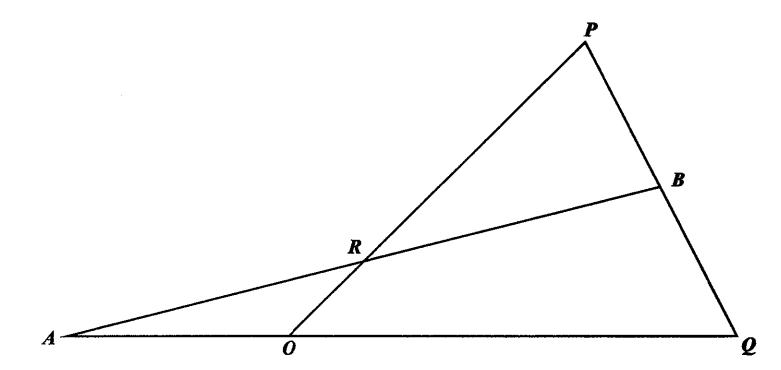
Find, in terms of \(\mathbf{a}\) and/or \(\mathbf{b}\), in its simplest form:
- (i) \(\vec{PQ}\) 1 mark
- (ii) \(\vec{AB}\) 2 marks
- (iii) \(\vec{OR}\) 2 marks
Click to reveal Worked Solutions
Use the path from \(P \rightarrow O \rightarrow Q\):
\[ \vec{PQ} = \vec{PO} + \vec{OQ} \] You are given:
\[ \vec{OP} = 4\mathbf{a} \quad\Rightarrow\quad \vec{PO} = -4\mathbf{a} \] \[ \vec{OQ} = 8\mathbf{b} \] So:
\[ \vec{PQ} = -4\mathbf{a} + 8\mathbf{b} \] Final answer:
\[ \boxed{\vec{PQ} = -4\mathbf{a} + 8\mathbf{b}} \]
Since \(B\) is the midpoint of \(PQ\), we first find \(\vec{OB}\):
\[ \vec{OB} = \vec{OP} + \frac{1}{2}\vec{PQ} = 4\mathbf{a} + \frac{1}{2}(-4\mathbf{a} + 8\mathbf{b}) = 4\mathbf{a} – 2\mathbf{a} + 4\mathbf{b} = 2\mathbf{a} + 4\mathbf{b} \] Assume \(A\) lies halfway along \(\vec{OQ}\), so:
\[ \vec{OA} = \frac{1}{2}\vec{OQ} = 4\mathbf{b} \] Then:
\[ \vec{AB} = \vec{OB} – \vec{OA} = (2\mathbf{a} + 4\mathbf{b}) – 4\mathbf{b} = 2\mathbf{a} \] Final answer:
\[ \boxed{\vec{AB} = 2\mathbf{a}} \]
Since \(R\) is the midpoint of \(AB\):
\[ \vec{OR} = \vec{OA} + \frac{1}{2}\vec{AB} \] From earlier:
\[ \vec{OA} = 4\mathbf{b}, \quad \vec{AB} = 2\mathbf{a} \] So:
\[ \vec{OR} = 4\mathbf{b} + \mathbf{a} \] Final answer:
\[ \boxed{\vec{OR} = \mathbf{a} + 4\mathbf{b}} \]
In the diagram below, \(O\) is the origin, \(\vec{OX} = \mathbf{u}\) and \(\vec{OY} = \mathbf{v}\). Points \(X\) and \(Y\) are the midpoints of \(OA\) and \(OB\) respectively.
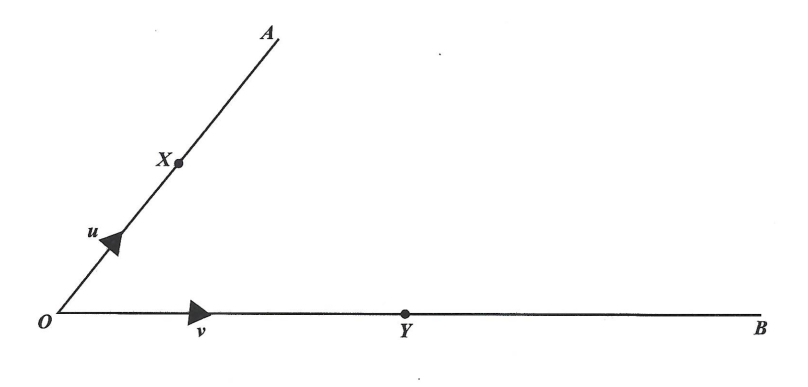
Find, in terms of \(\mathbf{u}\) and/or \(\mathbf{v}\), in its simplest form:
- (i) \(\vec{BX}\) 1 mark
- (ii) Given that \(YA\) and \(BX\) intersect at \(M\), and \(BM = 2MX\): (a) Express \(\vec{BM}\) in terms of \(\mathbf{u}\) and \(\mathbf{v}\) 1 mark
- (b) Using a vector method, show that the ratio \(YM : YA = 1 : 3\). Show all working. 3 marks
Click to reveal Worked Solutions
Use the triangle law from \(B \rightarrow O \rightarrow X\):
\[ \vec{BX} = \vec{BO} + \vec{OX} \] You are given:
\[ \vec{OY} = \mathbf{v} \quad\Rightarrow\quad \vec{OB} = 2\mathbf{v} \quad\Rightarrow\quad \vec{BO} = -2\mathbf{v} \] \[ \vec{OX} = \mathbf{u} \] So:
\[ \vec{BX} = -2\mathbf{v} + \mathbf{u} \] Final answer:
\[ \boxed{\vec{BX} = \mathbf{u} – 2\mathbf{v}} \]
Given \(BM = 2MX\), then \(M\) divides \(BX\) in the ratio \(2:1\). So \(M\) is \(\frac{2}{3}\) of the way from \(B\) to \(X\):
\[ \vec{BM} = \frac{2}{3}\vec{BX} = \frac{2}{3}(\mathbf{u} – 2\mathbf{v}) = \frac{2}{3}\mathbf{u} – \frac{4}{3}\mathbf{v} \] Final answer:
\[ \boxed{\vec{BM} = \frac{2}{3}\mathbf{u} – \frac{4}{3}\mathbf{v}} \]
Use the triangle law from \(Y \rightarrow M \rightarrow A\):
\[ \vec{YA} = \vec{YM} + \vec{MA} \quad\Rightarrow\quad \vec{YM} = \vec{YA} – \vec{MA} \] First, find \(\vec{YA}\): Since \(Y\) is midpoint of \(OB = 2\mathbf{v}\), then \(\vec{OY} = \mathbf{v}\) And since \(A = 2\mathbf{u}\), and \(X\) is midpoint of \(OA\), then \(\vec{OX} = \mathbf{u}\) So:
\[ \vec{YA} = \vec{YO} + \vec{OA} = -\mathbf{v} + 2\mathbf{u} \] From earlier, we found:
\[ \vec{BM} = \frac{2}{3}(\mathbf{u} – 2\mathbf{v}) \] So \(\vec{MX} = \frac{1}{3}(\mathbf{u} – 2\mathbf{v})\), and since \(X = \mathbf{u}\), \[ \vec{MA} = \vec{MX} + \vec{XA} = \frac{1}{3}(\mathbf{u} – 2\mathbf{v}) + \mathbf{u} = \frac{4}{3}\mathbf{u} – \frac{2}{3}\mathbf{v} \] Now compute \(\vec{YM}\):
\[ \vec{YM} = \vec{YA} – \vec{MA} = (2\mathbf{u} – \mathbf{v}) – \left(\frac{4}{3}\mathbf{u} – \frac{2}{3}\mathbf{v}\right) = \left(2 – \frac{4}{3}\right)\mathbf{u} + \left(-1 + \frac{2}{3}\right)\mathbf{v} = \frac{2}{3}\mathbf{u} – \frac{1}{3}\mathbf{v} \] So we now have:
\[ \vec{YM} = \frac{1}{3}(2\mathbf{u} – \mathbf{v}) = \frac{1}{3}\vec{YA} \] Conclusion:
\[ \boxed{\vec{YM} = \frac{1}{3}\vec{YA} \quad\Rightarrow\quad YM : YA = 1 : 3} \]
Three points \(O\), \(P\), and \(R\) are shown on the grid below. \(O\) is the origin.
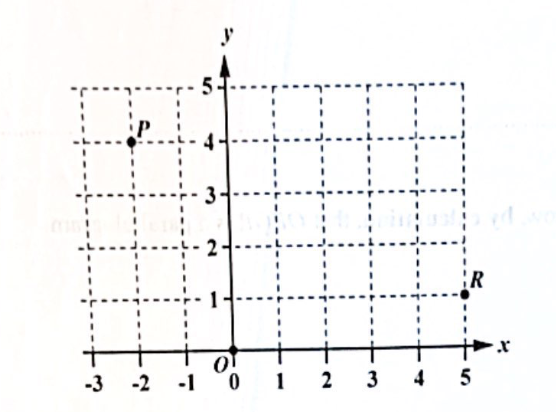
Answer the following questions:
- (i) Write the position vector of \(R\), \(\vec{OR}\), in the form \(\begin{pmatrix} a \\ b \end{pmatrix}\) 1 mark
- (ii) Another point \(Q\) is located such that \(\vec{QR} = \begin{pmatrix} 2 \\ -4 \end{pmatrix}\). Using this information, plot the point \(Q\) on the graph. 1 mark
- (iii) Determine \(|\vec{QR}|\), the magnitude of \(\vec{QR}\) 2 marks
- (iv) Show, by calculation, that \(OPQR\) is a parallelogram 3 marks
Click to reveal Worked Solutions
From the diagram, point \(R\) is at \((5, 1)\). So: \[ \vec{OR} = \begin{pmatrix} 5 \\ 1 \end{pmatrix} \] Final answer: \[ \boxed{\vec{OR} = \begin{pmatrix} 5 \\ 1 \end{pmatrix}} \]
You are given: \[ \vec{QR} = \begin{pmatrix} 2 \\ -4 \end{pmatrix} \] Use the path \(Q \rightarrow R\):
\[ \vec{OR} = \vec{OQ} + \vec{QR} \quad\Rightarrow\quad \vec{OQ} = \vec{OR} + \vec{RQ} \] With \(\vec{RQ} = -\vec{QR} = \begin{pmatrix} -2 \\ 4 \end{pmatrix}\):
\[ \vec{OQ} = \begin{pmatrix} 5 \\ 1 \end{pmatrix} + \begin{pmatrix} -2 \\ 4 \end{pmatrix} = \begin{pmatrix} 3 \\ 5 \end{pmatrix} \] So \(Q\) is at \((3, 5)\). Final answer: \[ \boxed{\vec{OQ} = \begin{pmatrix} 3 \\ 5 \end{pmatrix}} \]
\[ |\vec{QR}| = \sqrt{2^2 + (-4)^2} = \sqrt{4 + 16} = \sqrt{20} \] Final answer: \[ \boxed{|\vec{QR}| = \sqrt{20}} \]
From the diagram: \[ \vec{OP} = \begin{pmatrix} -2 \\ 4 \end{pmatrix}, \quad \vec{OQ} = \begin{pmatrix} 3 \\ 5 \end{pmatrix}, \quad \vec{OR} = \begin{pmatrix} 5 \\ 1 \end{pmatrix} \] Find \(\vec{PQ}\) using the path \(P \rightarrow O \rightarrow Q\):
\[ \vec{PQ} = \vec{PO} + \vec{OQ} \] With \(\vec{PO} = -\vec{OP} = \begin{pmatrix} 2 \\ -4 \end{pmatrix}\):
\[ \vec{PQ} = \begin{pmatrix} 2 \\ -4 \end{pmatrix} + \begin{pmatrix} 3 \\ 5 \end{pmatrix} = \begin{pmatrix} 5 \\ 1 \end{pmatrix} = \vec{OR} \] So: – \(\vec{PQ} = \vec{OR}\) Opposite sides \(PQ\) and \(OR\) are equal and parallel. Similarly, you can show \(\vec{QR} = -\vec{OP}\), so the other pair of opposite sides are also equal and parallel. Conclusion: \[ \boxed{OPQR \text{ is a parallelogram}} \]
Part (c)
The diagram below shows triangle \(OAB\) in which:
- \(\vec{OA} = \mathbf{r}\)
- \(\vec{OB} = \mathbf{s}\)
- \(\vec{OC} = \frac{3}{4}\vec{OA}\)
- \(\vec{AD} = \frac{2}{3}\vec{AB}\)
- \(E\) is the midpoint of \(CD\)
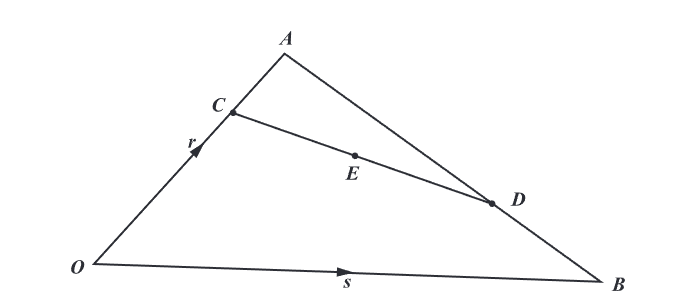
Write, in terms of \(\mathbf{r}\) and/or \(\mathbf{s}\), in its simplest form:
- (i) \(\vec{CD}\) 2 marks
- (ii) \(\vec{OE}\) 2 marks
Part (d)
The diagram below shows points \(O\), \(Q\), and \(R\) with coordinates:
- \(O = (0, 0)\)
- \(Q = (5, 2)\)
- \(R = (-1, 4)\)
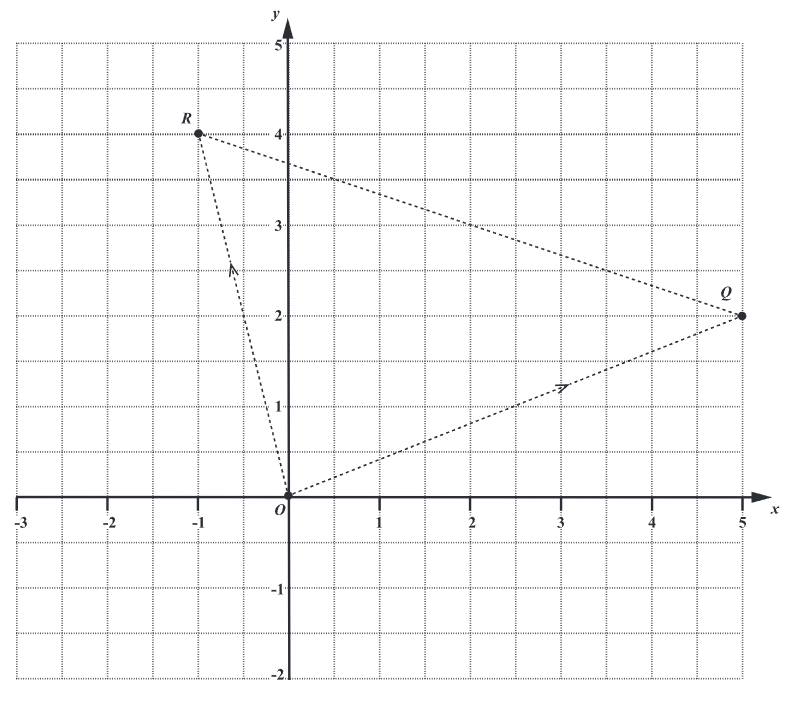
Answer the following questions:
- (i) Write \(\vec{OR}\) as a column vector 1 mark
- (ii) Determine vector \(\vec{QR}\) 2 marks
Click to reveal Worked Solutions
Use the path \(C \rightarrow A \rightarrow D\):
\[ \vec{CD} = \vec{CA} + \vec{AD} \] You are given: – \(\vec{OC} = \frac{3}{4}\vec{OA} = \frac{3}{4}\mathbf{r}\) – So \(\vec{CA} = \vec{CO} + \vec{OA} = -\frac{3}{4}\mathbf{r} + \mathbf{r} = \frac{1}{4}\mathbf{r}\) Also: – \(\vec{AB} = \vec{OB} – \vec{OA} = \mathbf{s} – \mathbf{r}\) – \(\vec{AD} = \frac{2}{3}\vec{AB} = \frac{2}{3}(\mathbf{s} – \mathbf{r})\) Now add: \[ \vec{CD} = \frac{1}{4}\mathbf{r} + \frac{2}{3}(\mathbf{s} – \mathbf{r}) = \frac{1}{4}\mathbf{r} + \frac{2}{3}\mathbf{s} – \frac{2}{3}\mathbf{r} \] Combine like terms: \[ \vec{CD} = \left(\frac{1}{4} – \frac{2}{3}\right)\mathbf{r} + \frac{2}{3}\mathbf{s} = -\frac{5}{12}\mathbf{r} + \frac{2}{3}\mathbf{s} \] Final answer: \[ \boxed{\vec{CD} = -\frac{5}{12}\mathbf{r} + \frac{2}{3}\mathbf{s}} \]
Since \(E\) is the midpoint of \(CD\):
\[ \vec{OE} = \vec{OC} + \frac{1}{2}\vec{CD} \] You are given: – \(\vec{OC} = \frac{3}{4}\mathbf{r}\) – From part (i): \(\vec{CD} = -\frac{5}{12}\mathbf{r} + \frac{2}{3}\mathbf{s}\) So: \[ \vec{OE} = \frac{3}{4}\mathbf{r} + \frac{1}{2}\left(-\frac{5}{12}\mathbf{r} + \frac{2}{3}\mathbf{s}\right) = \frac{3}{4}\mathbf{r} – \frac{5}{24}\mathbf{r} + \frac{1}{3}\mathbf{s} \] Combine: \[ \vec{OE} = \left(\frac{3}{4} – \frac{5}{24}\right)\mathbf{r} + \frac{1}{3}\mathbf{s} = \frac{13}{24}\mathbf{r} + \frac{1}{3}\mathbf{s} \] Final answer: \[ \boxed{\vec{OE} = \frac{13}{24}\mathbf{r} + \frac{1}{3}\mathbf{s}} \]
From the coordinates of point \(R = (-1, 4)\):
\[ \vec{OR} = \begin{pmatrix} -1 \\ 4 \end{pmatrix} \] Final answer: \[ \boxed{\vec{OR} = \begin{pmatrix} -1 \\ 4 \end{pmatrix}} \]
Use the path \(Q \rightarrow O \rightarrow R\):
\[ \vec{QR} = \vec{QO} + \vec{OR} \] From coordinates: \[ \vec{OQ} = \begin{pmatrix} 5 \\ 2 \end{pmatrix} \Rightarrow \vec{QO} = -\vec{OQ} = \begin{pmatrix} -5 \\ -2 \end{pmatrix} \] \[ \vec{OR} = \begin{pmatrix} -1 \\ 4 \end{pmatrix} \] Add: \[ \vec{QR} = \begin{pmatrix} -5 \\ -2 \end{pmatrix} + \begin{pmatrix} -1 \\ 4 \end{pmatrix} = \begin{pmatrix} -6 \\ 2 \end{pmatrix} \] Final answer: \[ \boxed{\vec{QR} = \begin{pmatrix} -6 \\ 2 \end{pmatrix}} \]