
Specialized Cells: Structure and Function
CSEC Biology - Understanding how cells adapt for specific roles in plants and animals
🔬 Learning Objectives
By the end of this article, you should be able to:
- Define cell specialization
- Identify the structural features of selected specialized cells
- Explain how structure relates to function in each cell type
- Compare different specialized cells
- Answer CSEC-style questions on specialized cells
What Are Specialized Cells?
Cell Specialization: The process by which cells develop specific structures and functions to perform particular tasks in multicellular organisms.
Why Specialization Matters: In multicellular organisms, different cells take on different jobs. This division of labor makes the organism more efficient.
Differentiation
The process by which cells become specialized
Tissue
A group of similar cells working together
Organ
A group of tissues performing a specific function
Structure-Function Relationship
CSEC Focus: You must be able to explain how a cell's structure helps it perform its function. This is a key exam skill.
Example: Red blood cells are biconcave (structure) to increase surface area for oxygen absorption (function).
Explore Specialized Cells
Click on a cell type to explore its structure and function:
Click on different cell types above to view their detailed structure
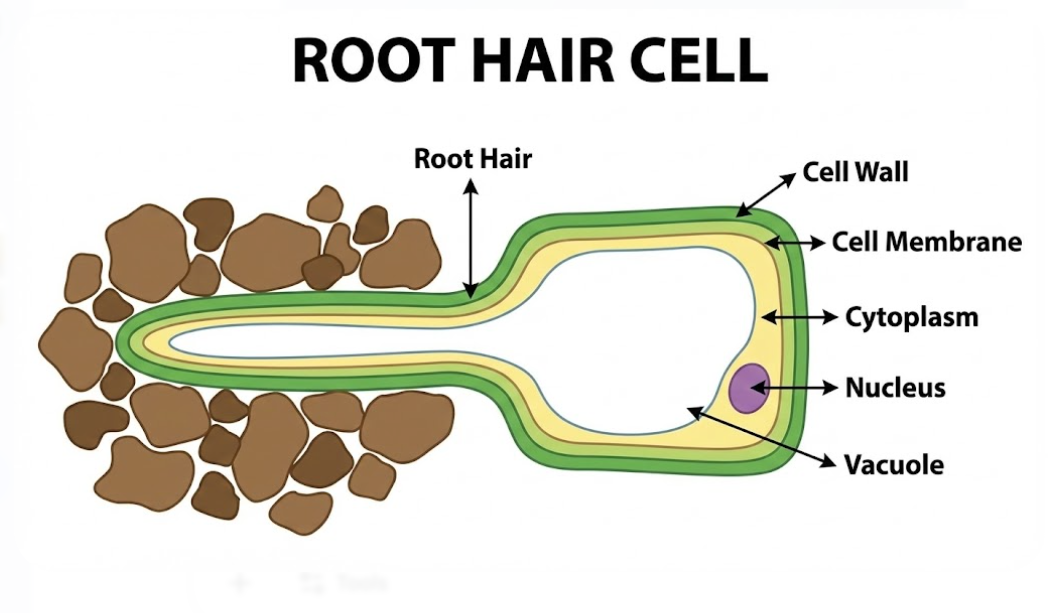
Root Hair Cell: Structure & Function
Key Structures
- Long hair-like extension
- Thin cell wall
- Large vacuole
- Many mitochondria
- Large surface area
Functions & Adaptations
- Absorbs water by osmosis
- Absorbs mineral ions by active transport
- Long extension increases surface area for absorption
- Many mitochondria provide energy for active transport
- Thin wall allows faster movement of substances
Comparison of Specialized Cells
This table helps you compare the key features for CSEC exams:
| Cell Type | Location | Key Structure | Main Function | Adaptation |
|---|---|---|---|---|
| Root Hair Cell | Root epidermis | Long extension | Absorption | Increases surface area |
| Red Blood Cell | Blood | Biconcave disc | Oxygen transport | No nucleus = more haemoglobin |
| Xylem Vessel | Plant stems/roots | Hollow tube | Water transport & support | Lignified walls |
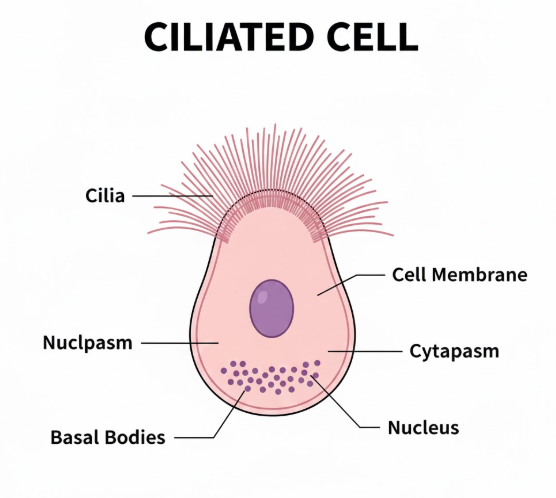
| Ciliated Cell | Trachea/Oviduct | Cilia on surface | Movement of substances | Beating cilia |
Study the cell images above and match each structure with its correct function:
Common CSEC Exam Errors
❌ Confusing Xylem with Phloem
Error: "Xylem transports sugars" (Wrong!)
Correction: Xylem transports water and minerals UPWARDS. Phloem transports sugars (sucrose) BOTH directions.
❌ Forgetting Red Blood Cells Lack Nucleus
Error: Describing red blood cells with a nucleus
Correction: Mammalian red blood cells lose their nucleus during development to make more space for haemoglobin.
❌ Describing Function Without Linking Structure
Error: "Root hair cells absorb water" (No structure mentioned)
Correction: "Root hair cells have long extensions that increase surface area for absorption of water and minerals."
❌ Mixing Up Cilia Locations
Error: "Ciliated cells are only in the trachea"
Correction: Ciliated cells are also found in the oviducts, where they help move eggs towards the uterus.
CSEC Exam Preparation
How Specialized Cells Appear in Exams
- Multiple Choice: Identifying structures or functions
- Diagram Labeling: Labeling parts of specialized cells
- Structure-Function Questions: "Explain how the structure of a red blood cell is related to its function" (4-6 marks)
- Comparison Questions: Comparing two specialized cells
Command Words in Specialized Cell Questions
- State: Give a single fact (1 mark)
- Describe: Give details about structure or function (2-3 marks)
- Explain: Give reasons why (3-4 marks)
- Relate: Connect structure to function (4-5 marks)
CSEC-Style Practice Questions
(2) No nucleus (in mammals)
(2) No cytoplasm/organelles - doesn't obstruct water flow
(3) Lignified walls - provide strength and support
(4) Dead at maturity - no metabolic processes to interfere with transport
B: Nucleus (or Cell membrane)
Red blood cell: Has a biconcave disc shape that increases surface area for faster diffusion of oxygen.
Both adaptations maximize surface area for their specific functions.
(2) Haemoglobin carries oxygen, so more haemoglobin means more oxygen can be transported
(3) Without a nucleus, the cell can be more flexible to squeeze through narrow capillaries