The Light Microscope: Parts and Calculating Magnification
CSEC Biology - Master microscopy skills for practical exams and School-Based Assessments
🔬 Learning Objectives
By the end of this article, you should be able to:
- Identify and state the functions of the parts of a light microscope
- Use a light microscope correctly and safely
- Calculate total magnification accurately
- Interpret microscope labels and diagrams
- Answer CSEC-style questions on microscopy
Why Microscopes Are Essential in Biology
The Power to See the Invisible: Microscopes allow us to observe cells, tissues, and microorganisms that are too small to see with the naked eye. This is fundamental to biology.
CSEC Practical Skills: You will use microscopes in:
- School-Based Assessments (SBAs): For biological drawings and observations
- Practical Exams: Identifying specimens and making measurements
- Theory Papers: Labeling diagrams and calculation questions
Microscopy
The use of microscopes to view objects that cannot be seen with the naked eye
Resolution
The ability to distinguish between two separate points
Magnification
How many times larger an image appears compared to the actual object
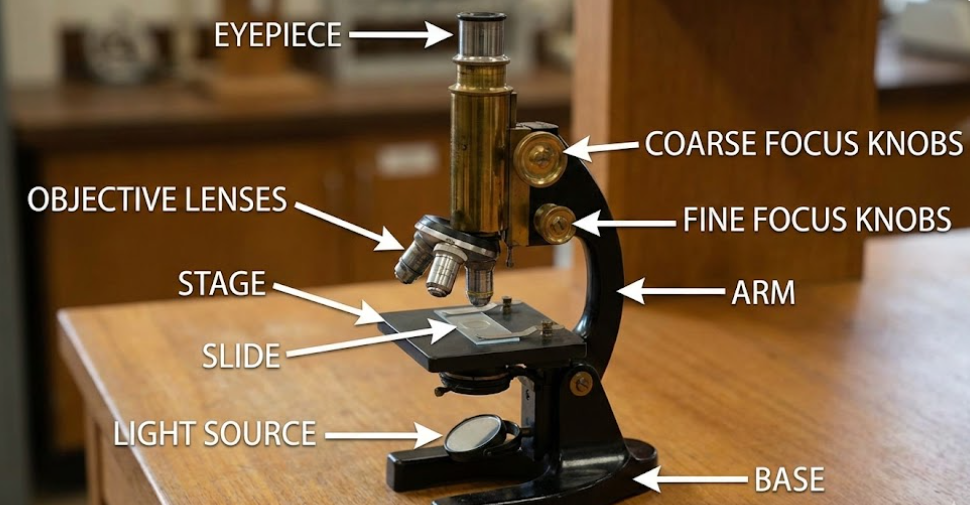
Parts of the Light Microscope
Click on the parts below to learn their functions:
Eyepiece (Ocular Lens)
Location: Top of microscope, where you look through
Function: Contains a lens that magnifies the image (usually 10×)
CSEC Tip: Always check the eyepiece magnification first when calculating total magnification
Objective Lenses
Location: Rotating nosepiece above the stage
Functions:
- Low power: 4× or 10× - for initial focusing
- Medium power: 20× or 40×
- High power: 40× or 100× - for detailed viewing
Stage and Stage Clips
Location: Flat platform below objective lenses
Function: Holds the microscope slide in place
CSEC Tip: Always use stage clips to secure slides - dropped slides can damage lenses!
Coarse and Fine Focus Knobs
Location: Usually on both sides of the microscope
Functions:
- Coarse focus: Large adjustments (use only on low power)
- Fine focus: Small adjustments (use on all powers)
Light Source
Location: Below the stage
Function: Provides light that passes through the specimen
Types: Built-in electric light or mirror (in older models)
Diaphragm
Location: Below the stage, controls light
Function: Adjusts the amount of light reaching the specimen
CSEC Tip: Adjust diaphragm for optimal contrast - not too bright, not too dim
Using the Light Microscope Correctly
Step-by-Step Focusing Procedure
- Place slide on stage and secure with clips
- Start with lowest power objective (4× or 10×)
- Use coarse focus to bring stage close to objective (watch from side!)
- Look through eyepiece and slowly turn coarse focus away
- Use fine focus to sharpen image
- Switch to higher powers, using fine focus only
Safety Precautions
- Always carry with two hands: One on arm, one under base
- Never use coarse focus on high power: Can crush slide and damage lens
- Clean lenses with lens paper only: Never use tissues or fingers
- Store covered: Prevent dust accumulation
❌ Common SBA Error
Error: Starting with high power objective
Result: Cannot find specimen, may damage slide
Correction: ALWAYS start with lowest power (4× or 10×)
Calculating Total Magnification
The Formula
Common Magnification Combinations
Low Power View
Eyepiece: 10×
Objective: 4×
Total: 40×
Medium Power View
Eyepiece: 10×
Objective: 10×
Total: 100×
High Power View
Eyepiece: 10×
Objective: 40×
Total: 400×
❌ Common Calculation Error
Error: Adding instead of multiplying
Wrong: 10× + 40× = 50×
Correct: 10× × 40× = 400×
Biological Drawings for SBA
SBA Requirement: You must produce clear, labeled biological drawings from microscope observations.
Rules for Biological Drawings
✅ Do This
- Use a sharp pencil
- Draw clear, continuous lines
- Label with straight lines
- Include magnification
- Add a title
❌ Avoid This
- No shading or coloring
- No arrowheads on labels
- Don't cross label lines
- Don't forget the scale
- No rough sketches
Practice labeling a microscope diagram:
Common CSEC Exam Errors
❌ Incorrect Magnification Calculation
Error: "The eyepiece is 10× and objective is 40×, so total is 50×"
Correction: Multiply, don't add! 10 × 40 = 400×
❌ Vague Function Statements
Error: "The stage holds things" (Too vague for marks)
Correction: "The stage provides a flat platform to hold and position the microscope slide, with clips to secure it in place."
❌ Confusing Resolution and Magnification
Error: "High magnification gives clearer images" (Not always true)
Correction: "Magnification makes images larger, but resolution determines clarity. High magnification without good resolution gives blurry images."
CSEC Exam & SBA Focus
How Microscopy Appears in Exams
- Multiple Choice: Magnification calculations, part functions
- Structured Questions: Labeling diagrams, step-by-step procedures
- SBA Practical: Using microscope, making drawings, measurements
Command Words in Microscopy Questions
- Label: Add names to parts of diagram (1 mark each)
- State: Give a single fact (1 mark)
- Calculate: Show working for magnification (2-3 marks)
- Describe: Give detailed steps (3-4 marks)
CSEC-Style Practice Questions
= 10 × 40
= 400×
100 ÷ 10 = 10
The 10× objective lens is being used.
(2) Start with lowest power objective (4× or 10×)
(3) Use coarse focus to bring stage close to lens (watch from side)
(4) Look through eyepiece and turn coarse focus away until image appears
(5) Use fine focus to sharpen image
(6) Switch to higher powers, using fine focus only